
The Science of Smell & How It Works on Us
Of all the human senses, smell is the most ancient, the most emotionally powerful and the least understood — both by science and by the people who experience it every day. Sight and hearing are processed by the neocortex, the brain's rational, analytical centre. Smell bypasses this entirely, connecting directly to the limbic system — the brain's emotional core — before conscious perception even occurs. This single neurological fact explains everything extraordinary about how fragrance affects us.
Why does a scent transport you instantly to a childhood memory? Why does your partner's natural scent feel like safety? Why can a single note in a fragrance trigger profound emotion before you can even name what you are smelling? The answers lie in the most remarkable sensory pathway in the human body — and understanding it transforms how you experience every fragrance you will ever wear.
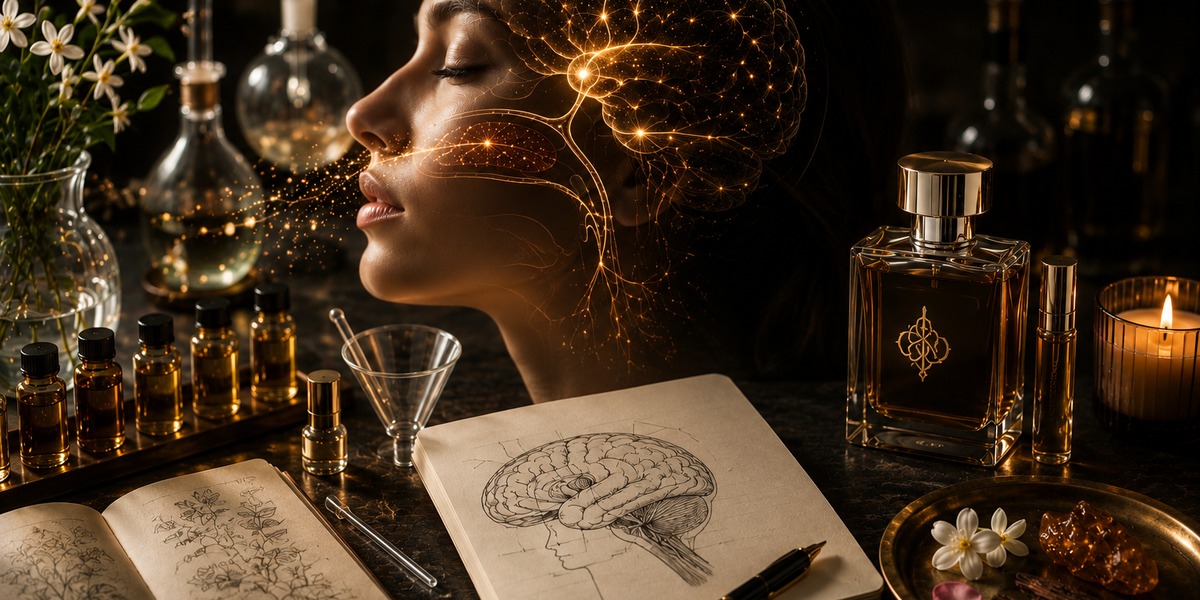
The journey from fragrance molecule to conscious scent experience is one of the fastest and most neurologically complex processes in the human body. It begins the moment you inhale and ends — remarkably quickly — in the most emotionally sensitive regions of the brain. Understanding this pathway illuminates why fragrance has the power to do things that no other sensory input can.
The reason fragrance has such profound emotional, psychological and physiological effects is not mystical — it is anatomical. The brain regions that olfactory signals reach first are precisely those most responsible for emotion, memory, desire, fear and behaviour. Here are the six key regions and what scent activation in each produces.
In 1913, Marcel Proust described in exquisite detail the experience of dipping a madeleine cake into tea and being instantly, overwhelmingly transported to his aunt's house in Combray — a memory so vivid and emotionally complete that it occupied thousands of words in his novel. He had discovered, through literature, what neuroscience would only confirm a century later: that smell is the most powerful trigger of involuntary memory that human beings possess.
The neurological reason is the direct connection between the olfactory bulb and the hippocampus — the brain's primary memory structure. Unlike visual or auditory memories, which are processed through the thalamus and neocortex before reaching memory centres, olfactory memories form direct, unmediated connections. This means scent-triggered memories arrive not as a rational recollection but as a full sensory re-experience — with the emotions, atmosphere and physical sensations of the original moment intact.
Research by Rachel Herz and Jonathan Schooler at Brown University demonstrated that scent-triggered memories are significantly more emotionally vivid and evocative than memories triggered by any other sense — and that they most frequently originate from the first decade of life, when the olfactory-memory system is at its most receptive. This is why a particular scent — a specific soap, a grandparent's home, a first romance — can remain locked in memory with extraordinary precision for an entire lifetime.
For perfumers, this understanding is not academic — it is creative. The most enduring fragrances are those that create their own olfactory memories: scents that become so associated with specific moments, relationships and emotions in a wearer's life that encountering them years later feels like stepping back into those moments entirely. Creating a fragrance that earns this relationship with its wearer is one of the highest ambitions of the craft.
Aromachology — the scientific study of how fragrance ingredients affect human psychology and physiology — has moved from the margins of behavioural science into a serious, well-funded field of research over the past three decades. The evidence it has produced is both fascinating and practically significant: specific aroma molecules have measurable, reproducible effects on human mood, stress levels, cognitive performance, alertness and even behaviour.
Lavender and linalool — the primary aroma molecule in lavender essential oil — have the most extensively documented anxiolytic effects in the scientific literature. Multiple randomised controlled trials have demonstrated that inhalation of lavender or linalool reduces anxiety, lowers cortisol levels, decreases heart rate and improves sleep quality. The mechanism involves GABA receptor modulation in the central nervous system — the same pathway as certain pharmaceutical anxiolytics, achieved through olfactory stimulation rather than ingestion.
Citrus molecules — particularly limonene from orange and lemon, and bergapten from bergamot — have demonstrated consistent mood-elevating and alertness-enhancing effects in research settings. Studies conducted in Japanese workplaces found that diffusing lemon fragrance reduced keyboard errors by 54% and orange fragrance by 20%. The mechanism is partly direct — citrus molecules appear to influence serotonin and dopamine pathways — and partly conditioned, through positive emotional associations.
Cedarwood and sandalwood components — particularly cedrol and santalol — have demonstrated sedative and anxiolytic effects in multiple studies, acting via the autonomic nervous system to reduce sympathetic activity and promote parasympathetic ("rest and digest") states. The traditional use of sandalwood in meditation and spiritual practice across Asian cultures reflects an empirical understanding of these effects that predates their scientific verification by millennia.
Rose and geraniol have demonstrated anti-depressant effects in animal and human studies, appearing to modulate serotonin and dopamine activity. The long cross-cultural association of rose with love, comfort and emotional wellbeing may reflect not just aesthetic preference but genuine neurochemical effect.
In 2004, Richard Axel and Linda Buck were awarded the Nobel Prize in Physiology or Medicine for their discovery of odorant receptors and the organisation of the olfactory system — research that fundamentally transformed scientific understanding of how humans detect and distinguish scent. Their work, conducted independently and together through the early 1990s, revealed the extraordinary molecular machinery that makes human olfaction possible.
Axel and Buck discovered that humans possess a family of approximately 400 functional olfactory receptor genes — a remarkable number representing roughly 3% of the entire human genome, suggesting that smell has been critically important to human survival throughout evolutionary history. Each olfactory receptor neuron expresses only one type of receptor protein, creating a combinatorial system in which different combinations of receptor activation produce different perceived scents.
This combinatorial logic is what gives human smell its extraordinary range. With 400 receptor types, each capable of being activated at varying intensities by different molecules, the theoretical number of distinguishable scent combinations runs into the trillions. Research published in Science in 2014 by Bushdid and colleagues at Rockefeller University estimated the human nose can discriminate over one trillion distinct odours — dramatically revising upward the previous estimate of 10,000 and confirming smell as the most diverse of all the human senses in terms of discriminatory range.
The Nobel research also illuminated why olfactory sensitivity is so highly individual — each person's pattern of receptor gene expression varies slightly, producing genuine differences in what people can and cannot smell, how intensely they perceive specific molecules, and what combinations smell beautiful or unpleasant to them. This is the scientific foundation of specific anosmia and the deeply personal nature of fragrance preference.
The neuroscience of smell does not diminish the mystery of fragrance — it deepens it. Understanding that a scent bypasses rational thought to reach the emotional brain first; that it triggers memories with a vividness no visual or auditory stimulus can match; that specific molecules have measurable effects on mood, stress and cognition; that every person's olfactory system is subtly but genuinely unique — all of this reveals why fragrance matters in ways that go far beyond aesthetics.
At Scensora, this understanding fundamentally shapes how we approach bespoke creation. We do not create fragrances merely to smell pleasant. We create fragrances that function as emotional architecture — shaping how the wearer feels, how others respond to them, and what memories and associations the scent builds over time into something deeply personal and irreplaceable.
When a client describes their brief as "I want to feel calm but present," or "I want this to remind me of my grandmother's garden," or "I want to smell the way I feel when I'm most confident," they are describing not an aesthetic preference but a neurological intention. They are asking us to compose something that will interact with their limbic system, their hippocampus and their unique receptor profile in a specific, deliberate way.
This is why bespoke fragrance is the most intimate and personal of all the luxury crafts. A painting hangs on a wall. Music plays through a speaker. But a fragrance enters your nervous system — directly, personally and continuously. Nothing else does that. And nothing else, when it is done right, can affect you in quite the same way.
The science of smell is ultimately the science of what makes us human. Our olfactory system is ancient — far older than language, older than rational thought, older than civilisation. It connects us to our evolutionary past, to our emotional present and to the memories that define who we are. When we create a fragrance at Scensora, we are not just blending ingredients — we are composing something designed to interact with this extraordinary system. That responsibility is one we approach with the humility, precision and reverence it deserves.
- Smell is the only sense that bypasses the thalamus, connecting directly to the limbic system — reaching emotion and memory before conscious thought.
- The olfactory pathway from nostril to limbic system is the shortest, most direct sensory route to the brain that exists in the human body.
- Scent activates six key brain regions: amygdala (emotion), hippocampus (memory), piriform cortex (identification), hypothalamus (physiology), orbitofrontal cortex (evaluation) and nucleus accumbens (reward).
- The Proustian memory effect is neurologically real — scent-triggered memories are measurably more emotionally vivid than those triggered by any other sense.
- Specific aroma molecules have documented effects on mood, anxiety, alertness and cognition — linalool (calming), limonene (energising), cedrol (sedative), geraniol (mood-lifting).
- Humans can distinguish over one trillion distinct odours — more than any other sensory discrimination capacity we possess.
- The 2004 Nobel Prize revealed that ~3% of the human genome is devoted to olfactory receptors — confirming smell as evolutionarily critical to human survival.