
Why Does Perfume Smell Different on Everyone?
You spray the same fragrance as a friend and it smells entirely different on you. Your partner's cologne smells magnificent on them and flat on you. A fragrance you loved in the store vanishes on your skin within two hours. These experiences are universal — and they are not accidents, coincidences or failures of the fragrance. They are the result of a fascinating and deeply personal biological chemistry between you and every scent you wear.
Understanding why perfume smells different on everyone does more than satisfy curiosity. It fundamentally changes how you choose, wear and think about fragrance — and it explains precisely why a truly bespoke fragrance, built for your specific biology and chemistry, performs in a way that no off-the-shelf bottle ever fully can.
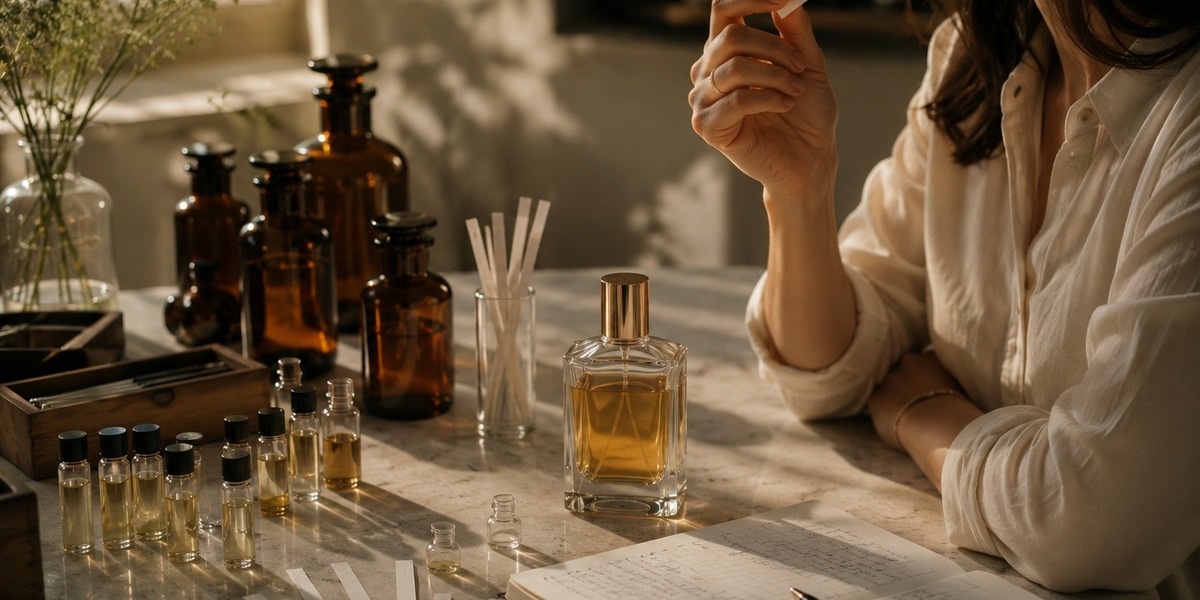
The single most significant factor in how a fragrance performs on your body is your skin chemistry — the unique combination of natural oils, pH levels, moisture content, microbiome composition and metabolic by-products that your skin continuously produces. This chemistry is as individual as a fingerprint, and it interacts with fragrance molecules in ways that are genuinely unpredictable from person to person.
Skin pH plays a critical role. The average human skin pH sits between 4.5 and 6.5 — slightly acidic — but this varies significantly between individuals, across different body regions and at different times of day. Acidic skin tends to amplify certain note families — particularly musks and ambers — while neutralising others. Alkaline skin reacts differently, often projecting citrus and floral notes with greater intensity.
Natural skin oils are the primary vehicle through which fragrance molecules travel and evaporate. People with naturally oilier skin have a richer lipid surface that binds fragrance molecules, slowing their evaporation and extending wear. The same fragrance that lasts three hours on very dry skin may last eight hours or more on naturally oily skin — not because the fragrance is different, but because the surface it lands on is.
The skin microbiome — the community of bacteria, fungi and other microorganisms that live on your skin — also influences how fragrance molecules break down and transform over time. Research suggests that individual microbiome composition contributes meaningfully to the unique "skin scent" that everyone naturally produces, and that this base note interacts with applied fragrance in highly individual ways.
Beyond baseline skin chemistry, a constellation of variables continuously shapes the interaction between fragrance and your body. Understanding each one transforms how you select and wear scent.
The difference in how fragrance smells on different people is not only about how the skin transforms the formula — it is also about how the nose perceives what the skin presents. Olfactory perception is profoundly individual, shaped by genetics, age, experience, culture and a neurological phenomenon called olfactory adaptation.
Specific anosmia — the inability to detect one or more specific odour molecules — is far more common than most people realise. Research suggests that up to 50% of people cannot detect the clean, woody scent of Iso E Super, one of the most widely used aroma chemicals in modern perfumery. A significant proportion of people cannot detect the primary musk notes in many popular fragrances. This means that some of the most celebrated modern fragrances are genuinely invisible to a substantial portion of their wearers.
Olfactory adaptation — also known as "nose blindness" — occurs when your olfactory system habituates to a continuously present scent and stops registering it consciously. This is why you often cannot smell your own fragrance after wearing it for an hour, while those around you remain fully aware of it. You have not lost the scent — your brain has simply deprioritised a familiar, constant signal to focus on new olfactory information.
Cultural and experiential conditioning also shapes perception profoundly. Scents associated with positive memories and emotions are experienced more pleasurably and more intensely than objectively identical scents encountered without that emotional context. A fragrance that smells transcendent to someone who associates it with a cherished memory may smell ordinary to someone encountering it without that association.
Your relationship with fragrance is not static — it changes throughout your life as your body chemistry and olfactory sensitivity evolve. Understanding these changes helps explain why fragrances that captivated you in your twenties may feel different in your forties, or why certain scent families become more or less appealing at different life stages.
Hormonal fluctuations have a profound effect on both skin chemistry and olfactory sensitivity. Women often report that their fragrance preferences and sensitivity shift noticeably across the menstrual cycle — becoming more drawn to musky, animalic scents at certain hormonal phases and more sensitive to sharp or synthetic materials at others. Pregnancy dramatically alters olfactory sensitivity, often heightening it to the point where previously loved fragrances become intolerable.
Age and skin change significantly affect fragrance performance. As skin ages, it produces less natural sebum — the oil that binds and extends fragrance. This means fragrances that once lasted all day may fade more quickly as you age, while very light, fresh fragrances may project less than they once did. Older skin tends to work better with richer, more concentrated formulas — Extrait de Parfum or oriental concentrations — that compensate for reduced natural oils.
Olfactory sensitivity naturally declines with age. Research suggests that peak olfactory performance occurs in early adulthood, gradually diminishing from middle age onward. This does not diminish the pleasure of fragrance — but it does mean that the same formula may smell more intense to a twenty-five-year-old than to a sixty-year-old, which is worth considering when choosing concentration and projection.
Understanding your skin's relationship with fragrance is not an abstract exercise — it has very practical implications for how you should test, select and wear scent. Most people choose fragrance incorrectly, making decisions based on blotter strips or initial sprays that bear little resemblance to how the fragrance will behave on their skin after an hour.
Always test on skin, never on paper. Fragrance blotter strips are useful for initial elimination — identifying notes you actively dislike — but they tell you almost nothing about how a formula will interact with your chemistry, project from your skin or evolve over time. Apply to the inner wrist, wait 30 minutes, then evaluate. If possible, live with it for two hours before committing.
Test in your real-life environment. A fragrance that smells magnificent in a cool, air-conditioned store may smell completely different after 30 minutes in a warm, humid Southeast Asian afternoon. Your body temperature, perspiration and the ambient environment all contribute to the final result.
Limit testing to two fragrances per session. Olfactory fatigue sets in quickly, and testing more than two or three fragrances simultaneously compromises your ability to evaluate any of them accurately. Take breaks, reset your nose with coffee grounds or a neutral scent, and return with fresh perception.
Every factor discussed in this article points toward the same conclusion: fragrance is irreducibly personal. The same formula smells different on every person who wears it, performs differently across different skin types and climates, and is perceived differently by every nose that encounters it. This is not a problem to be solved — it is the defining characteristic of what makes fragrance such an intimate art form.
It does, however, create a fundamental limitation for any fragrance created without reference to the individual who will wear it. A designer fragrance is built to smell appealing on the widest possible range of skin chemistries — which means it is optimised for no one in particular. A niche fragrance is built to express a specific creative vision — which may or may not align with how your skin interprets it.
A bespoke fragrance, by contrast, is built for you specifically. At Scensora, our process begins with understanding your skin chemistry, your lifestyle, your climate and your wearing environment. The formula we develop is calibrated to your biology — the base notes chosen to work with your skin's natural oils, the concentration adjusted to your body's natural projection, the ingredient selection guided by your olfactory profile and sensitivities.
The result is a fragrance that does not just smell good in the abstract — it smells exactly right on you. Not because of chance, but because it was never designed for anyone else.
The most common fragrance mistake people make is treating fragrance as a fixed object — something that smells a certain way, full stop. In reality, fragrance is a conversation between the formula and the person wearing it. The formula provides the vocabulary; your biology provides the voice. Understanding this transforms how you experience every scent you encounter — and why the only fragrance that can ever be truly perfect for you is one built to speak in your voice from the very first drop.
- Skin chemistry — pH, natural oils, microbiome — is the primary reason the same fragrance smells different on different people.
- Body temperature, diet, hydration, medications and skincare all continuously alter how fragrance develops on your skin.
- Up to 50% of people cannot detect certain key fragrance molecules — specific anosmia is far more common than most realise.
- Olfactory adaptation ("nose blindness") means you stop consciously smelling your own fragrance long before others do.
- Hormones, age and skin changes shift your fragrance preferences and performance throughout your life.
- Always test fragrance on skin, in your real environment, and allow at least 30 minutes before evaluating.
- Bespoke fragrance eliminates the guesswork — it is calibrated to your biology from the first formulation decision.