
Niche vs Designer Fragrance: What's the Difference?
Walk into any department store and you are immediately in the world of designer fragrance — gleaming counters, celebrity-fronted campaigns, familiar names from fashion's most iconic houses. Walk into a specialist perfumery, a niche boutique or a bespoke studio, and you enter an entirely different universe: one defined by craft, provenance, unconventional ingredients and stories that have nothing to do with mass appeal.
The distinction between niche and designer fragrance is one of the most discussed and least understood divisions in the fragrance world. For the consumer, it represents a fundamental choice about what you want from a scent — and from the experience of wearing it. This article unpacks that choice with clarity and without snobbery.
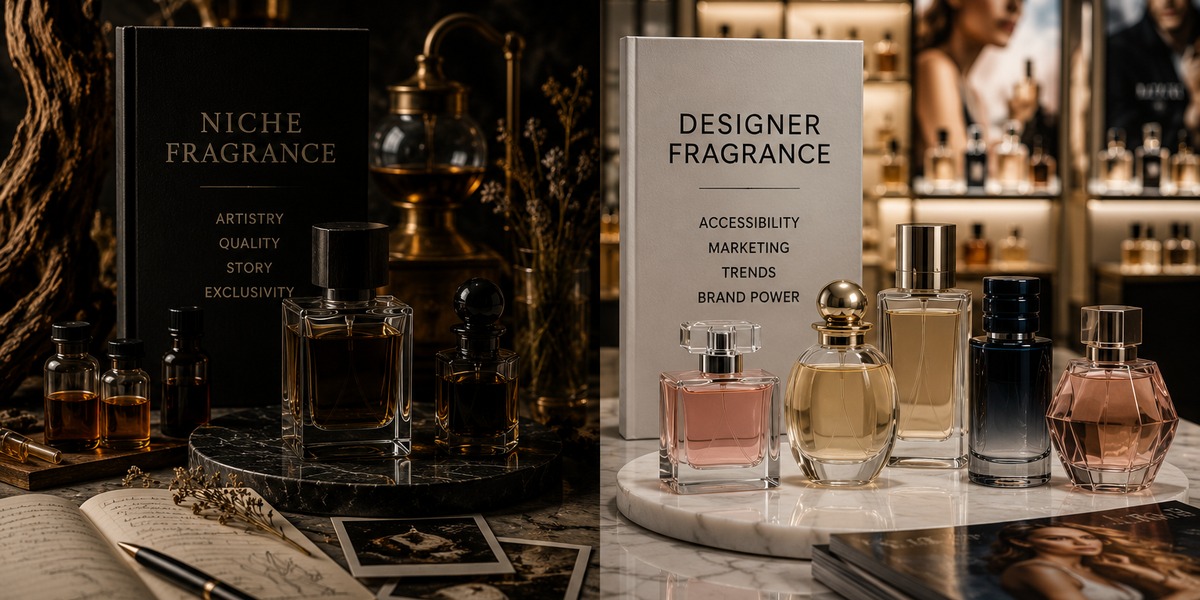
Designer fragrance refers to fragrances produced by or under licence from major fashion, luxury and lifestyle houses — Chanel, Dior, Gucci, Giorgio Armani, Versace, Hugo Boss, Calvin Klein and their peers. These are fragrances created primarily for mass commercial distribution, designed to appeal to the broadest possible audience, supported by multi-million dollar global marketing campaigns and sold through department stores, duty-free outlets and mainstream retail channels worldwide.
The business model of designer fragrance is fundamentally one of scale. A single major designer launch may be produced in quantities of millions of bottles, distributed across hundreds of countries and marketed through celebrity endorsements, print campaigns and digital advertising. The fragrance itself is often a secondary consideration to the brand identity it is meant to reinforce. The perfumer who creates it is almost never named.
Niche fragrance — also called artisan, indie or independent fragrance — operates on entirely different principles. Niche houses exist specifically to create fragrance as an art form, with no obligation to appeal to a broad audience and no pressure from a parent company's quarterly earnings targets. Their distribution is deliberately limited, their production volumes are small and their creative freedom is absolute.
The word "niche" does not refer to price point, though niche fragrances are typically more expensive than their designer counterparts. It refers to market position — these are fragrances designed for a specific, knowledgeable, deeply engaged audience rather than the mass market. Houses like Amouage, Diptyque, Byredo, Creed, Maison Francis Kurkdjian and Serge Lutens define the upper echelons of this world.
Understanding the structural differences between niche and designer fragrance goes far beyond aesthetics. These are fundamentally different industries operating under fundamentally different constraints, incentives and creative philosophies.
- Perfumer is often named and celebrated
- Ingredient budgets prioritise quality over cost
- Creative freedom — no mass-appeal brief
- Limited, curated distribution channels
- Small batch, often hand-finished production
- Complex, unconventional, sometimes challenging
- Built for the fragrance connoisseur
- Higher price reflects ingredient and craft cost
- Longevity and projection often superior
- Story and provenance are central
- Perfumer rarely credited publicly
- Ingredient budgets constrained by retail price targets
- Brief shaped by marketing and commercial positioning
- Global mass-market distribution
- Industrial-scale production
- Crowd-pleasing, accessible, broadly wearable
- Built for the widest possible audience
- Price reflects brand equity and marketing spend
- Longevity sometimes compromised by cost reduction
- Celebrity association and brand story are central
One of the most important — and most misunderstood — differences between niche and designer fragrance lies in where the money in the bottle's price actually goes. This question is critical because many consumers assume that a £200 designer fragrance must contain £200 worth of ingredients. It almost certainly does not.
Major fragrance industry analyses have consistently found that the fragrance compound itself — the actual scented liquid — typically accounts for between 3% and 10% of the retail price of a major designer fragrance. The remainder covers packaging, marketing, retail margin, celebrity endorsement fees, distribution costs and brand licensing. A £150 designer EDP may contain less than £5 worth of fragrance compound.
Niche fragrances operate differently. With minimal advertising budgets, no celebrity contracts and limited retail markups, a significantly higher proportion of the retail price is directed toward the formula itself. A £200 niche EDP may contain £40 to £80 worth of carefully selected, high-grade raw materials — including genuine natural essences, expensive aroma chemicals and rare ingredients that simply could not be included in a mass-market formula at any viable price point.
This does not mean all designer fragrances are cynical exercises in marketing — some of the finest fragrances ever created have been produced by major houses with full creative investment. But it does mean that the relationship between price and formula quality is fundamentally different across the two worlds.
One of the most significant and least publicised issues in designer fragrance is reformulation — the practice of altering an existing fragrance formula, typically to reduce costs, comply with updated IFRA regulations, or substitute discontinued or restricted ingredients. Reformulations are almost never announced publicly, and the new version is sold in identical packaging to the original.
The consequences for fragrance lovers can be devastating. Beloved classics — Guerlain's Mitsouko, Chanel No. 5, Dior's Fahrenheit, many of Thierry Mugler's Angel variations — have been reformulated multiple times over the decades. In many cases, enthusiasts argue that the modern version bears only a superficial resemblance to the original, with the loss of now-restricted naturals such as oakmoss, certain citruses and animal-derived materials fundamentally altering the character of the fragrance.
Niche fragrances are not immune to reformulation — IFRA regulations affect all producers equally — but the smaller production volumes, stronger craft identity and closer relationship between niche houses and their customers creates both a greater reluctance to reformulate and a greater transparency when it must occur.
The fragrance community has a tendency toward niche snobbery — an assumption that niche equals better and designer equals compromised. This is a comfortable narrative that the evidence does not always support. The reality is considerably more nuanced.
Some of the greatest fragrances ever created are designer: Chanel No. 5, created by Ernest Beaux in 1921, remains a masterpiece of modern perfumery regardless of its commercial ubiquity. Dior's Eau Sauvage, Hermès' Un Jardin sur le Nil, Guerlain's L'Heure Bleue — these are works of genuine artistic achievement from major commercial houses, created by perfumers of extraordinary talent.
Not all niche is excellent: The growth of the niche market has attracted producers whose primary motivation is the premium price point rather than genuine creative ambition. A high price, an obscure ingredient list and a compelling backstory do not automatically constitute quality. Some of the most overpriced and underwhelming fragrances in existence occupy niche shelf space.
The real question is not niche vs designer — it is craft vs compromise. A designer house that invests in genuine creative talent, real ingredients and thoughtful formula construction can produce something extraordinary. A niche house that prioritises marketing over substance produces nothing worthwhile at any price. The discriminating consumer evaluates the fragrance, not the category.
If designer fragrance speaks to the crowd and niche fragrance speaks to the connoisseur, bespoke fragrance speaks to one person alone. It represents the ultimate evolution of the niche philosophy — not a fragrance created for a defined audience of enthusiasts, but a fragrance created for a single individual, built entirely around their story, their skin chemistry, their personality and their desires.
Bespoke perfumery sits beyond the niche category in every meaningful dimension. There is no brief shaped by commercial considerations, no distribution channel to satisfy, no price point to engineer toward. The only question is what this person needs their fragrance to be — and how to achieve that with the finest ingredients and the most skilled craftsmanship available.
At Scensora, we work with clients who have worn the finest niche fragrances in the world and still felt that something was missing — that the fragrance was someone else's vision, not theirs. Bespoke creation resolves this entirely. The result is not a fragrance that you choose from — it is a fragrance that could not exist without you. That is the difference that matters most.
The niche vs designer debate is ultimately a conversation about values — what you believe fragrance is for, what you want it to express about you and how much you are willing to invest in a scent experience that is genuinely your own. Neither world is inherently superior. But understanding the differences between them gives you the knowledge to make choices that truly reflect who you are — rather than who a brand's marketing department has decided you should be.
- Designer fragrance prioritises mass appeal, global distribution and brand identity; niche prioritises craft, ingredients and creative freedom.
- In a designer fragrance, as little as 3–10% of the retail price may reflect the actual formula cost — the rest is marketing, packaging and brand equity.
- Niche fragrance directs a significantly higher proportion of its price toward ingredient quality and formulation craft.
- Reformulation silently changes beloved designer classics — research vintage editions of your favourites.
- Not all niche is excellent and not all designer is compromised — evaluate the fragrance, not the category.
- Bespoke perfumery transcends both categories — it is fragrance created for one person alone.