
Oud Perfume: The Complete Guide
Few ingredients in the world of perfumery command the reverence, mystique and desire that oud does. Known as liquid gold, black gold, and the wood of the gods, oud has been treasured for over three thousand years across the Middle East, South Asia and East Asia — burned as incense in royal courts, worn as a mark of distinction, and gifted as one of the highest expressions of luxury.
Today, oud has crossed every cultural and geographical boundary. It is found in the most exclusive niche perfumes and the boldest mainstream releases alike. Yet despite its ubiquity, genuine oud remains one of the most misunderstood, mislabelled and counterfeited ingredients in the fragrance world. This guide exists to change that.
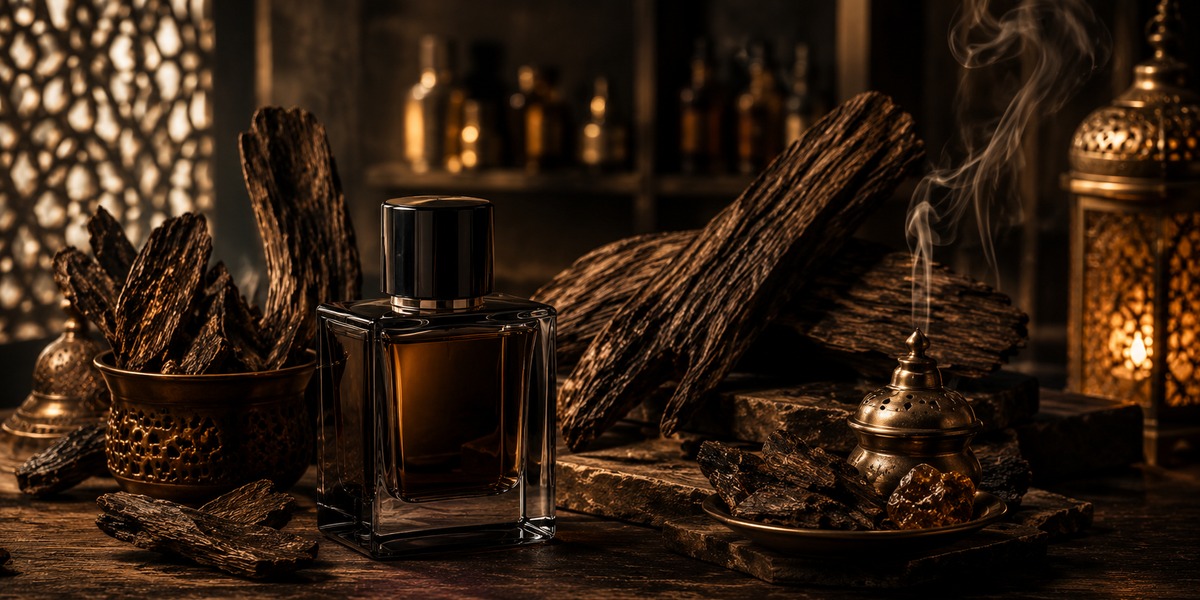
Oud — also known as agarwood, oudh, aloeswood or eaglewood — is a dark, resinous heartwood that forms inside Aquilaria trees, a genus native to the rainforests of Southeast Asia, South Asia and parts of the Middle East. Under normal conditions, Aquilaria wood is pale, light and odourless. But when infected by a specific mould — Phialophora parasitica — the tree produces a dark, fragrant resin as a defence mechanism. It is this resin-saturated heartwood that becomes oud.
The process takes years — sometimes decades — to fully develop. Only a fraction of Aquilaria trees in the wild ever produce agarwood of sufficient quality for perfumery. This extraordinary rarity is the foundation of oud's value. Wild-harvested oud of the finest grade can cost more per kilogram than gold — making it, quite literally, one of the most expensive natural materials on Earth.
Oud has been documented in some of the oldest texts in human history — referenced in Sanskrit writings, the Bible, the Quran and ancient Chinese manuscripts. In the Middle East, burning oud chips — bukhoor — before guests arrives remains one of the most generous acts of hospitality a host can offer.
The journey from forest to fragrance is one of the most labour-intensive in the natural world. Wild oud trees are located deep in remote forests — in Cambodia, Laos, Vietnam, Indonesia, India, Bangladesh and Papua New Guinea — and harvesting infected heartwood requires experienced trackers who can identify trees that have undergone resin formation, which shows no external signs visible to the untrained eye.
Once harvested, the resinous wood is steam-distilled to extract oud essential oil. The yield is extraordinarily low — it can take up to 20 kilograms of quality agarwood to produce just one kilogram of oud oil, and distillation can take 10 to 15 days of continuous steam extraction. The resulting oil is dense, complex and extraordinarily concentrated.
Due to the near-exhaustion of wild Aquilaria trees — the species is now listed as endangered on CITES — the industry has increasingly turned to plantation-grown oud, where trees are deliberately inoculated with the mould to induce resin formation. While plantation oud lacks the depth and complexity of old-growth wild oud, advances in inoculation techniques are producing plantation oils of increasingly impressive quality.
One of the most important things to understand about oud is that it is not a single, uniform ingredient. The origin of the wood, the species of Aquilaria, the distillation method and the age of the resin all produce dramatically different scent profiles. Understanding these differences transforms how you experience and choose oud fragrances.
| Origin | Character | Notes | Best For |
|---|---|---|---|
| Hindi (India) | Deep, animalic, barnyard, leather | Smoky, dark, earthy, intensely resinous | Those seeking the most raw, traditional oud experience |
| Cambodi (Cambodia) | Sweet, fruity, honeyed, warm | Dried fruit, amber, gentle smoke, subtle wood | First-time oud wearers, approachable luxury |
| Malay (Malaysia) | Floral, green, clean | Cool, slightly medicinal, fresh wood, soft rose | Warm climates, daytime wear, lighter profiles |
| Laotian | Balanced, elegant, complex | Light spice, creamy wood, gentle sweetness | Sophisticated, versatile, refined wear |
| Papua New Guinea | Earthy, green, tropical | Forest floor, humid wood, herbal | Adventurous, nature-inspired profiles |
The vast majority of fragrances marketed as "oud" today do not contain a single drop of genuine oud oil. This is not necessarily deceptive — synthetic oud molecules have become extraordinarily sophisticated, and many deliver a compelling oud-adjacent experience at a fraction of the cost. But understanding the difference is essential for any serious fragrance lover.
Genuine natural oud oil is extraordinarily expensive. A small bottle of high-grade Hindi or Cambodi oud oil can cost hundreds to thousands of dollars per gram. This makes its inclusion in a mass-market fragrance at any meaningful concentration commercially impossible. Most mainstream "oud" fragrances use synthetic agarwood molecules — the most common being Agarwood CO₂, Oud Wood accord bases, Cypriol (nagarmotha) and Iso E Super — to approximate the oud effect.
At the artisan and niche level, genuine oud oil is used — sometimes as the centrepiece of a formula, sometimes as a subtle supporting note to add depth and animalic warmth. At Scensora, we work with certified natural oud oils from traceable, sustainable sources — giving our bespoke clients access to an ingredient that most commercial fragrances can only allude to.
The tell? Natural oud evolves dramatically on the skin over hours — its opening is often sharp and medicinal, softening through smoke and leather before settling into a deep, sweet, resinous dry-down that can last for days. Synthetic oud tends to be linear, consistent and predictable — which has its own appeal, but lacks the living complexity of the real thing.
Oud is one of the most misunderstood fragrances when it comes to wear — many people assume it is exclusively a night-time, cold-weather, formal ingredient. This is a misconception. The right oud fragrance — and the right application — can work beautifully in almost any context.
In warm, humid climates — Southeast Asia, the Middle East in summer — choose a Malay or Cambodi-style oud: lighter, greener, sweeter. Apply sparingly to pulse points. Oud amplifies with heat, so less is almost always more in tropical conditions. A single drop on the wrist and behind the ear is often sufficient to project beautifully all day.
In cooler climates and evening settings — Hindi and Laotian ouds come alive. Their animalic depth, smokiness and leather nuances are perfectly suited to winter evenings, formal events and intimate settings where a powerful, long-lasting scent is an asset rather than an intrusion.
For daily wear — modern oud blends that combine oud with rose, sandalwood, vetiver or citrus create beautifully wearable, refined expressions that work equally well in office environments, social settings and travel. The key is balance — oud as a supporting character rather than the sole protagonist.
At Scensora, oud occupies a central and deeply considered place in our bespoke fragrance work. We do not treat oud as a trend ingredient or a marketing claim — we use it as master perfumers have for centuries: with respect, precision and purpose.
Every oud we work with is sourced from verified, sustainable suppliers across Cambodia, Malaysia, India and Laos. We offer our bespoke clients the rare opportunity to work with genuine natural oud oil — selecting the origin, the character and the concentration that best serves their unique scent story.
Our most celebrated oud creations blend traditional Middle Eastern oud construction — rich, resinous, deeply intimate — with the preferences and cultural nuances of our Southeast Asian and international clientele. Siam Oud, one of our most requested bespoke signatures, fuses Cambodi sweetness with Thai jasmine, vetiver from Haiti and a white musk foundation — creating an oud experience that is simultaneously deeply rooted and utterly modern.
Whether oud is the centrepiece of your fragrance or a subtle backbone that adds depth and longevity, we treat it as what it truly is — one of the most remarkable natural materials the world has ever produced.
Oud is the ingredient that most clearly separates genuine fragrance expertise from surface-level trend-following. Understanding where it comes from, how it is produced, and how to wear it transforms oud from an intimidating luxury into one of the most deeply personal and culturally resonant fragrances you will ever experience. At Scensora, we believe everyone deserves to experience real oud — crafted with integrity, worn with intention.
- Oud is formed when Aquilaria trees produce defensive resin in response to mould infection — a rare, decades-long natural process.
- Different origins — Hindi, Cambodi, Malay, Laotian — produce dramatically different scent profiles, from animalic and smoky to sweet and floral.
- Most commercial "oud" fragrances use synthetic molecules — genuine natural oud oil is extraordinarily rare and expensive.
- Oud evolves dramatically on the skin over hours, offering a living, complex experience that synthetic versions cannot fully replicate.
- In warm climates, apply sparingly — oud amplifies with heat. In cooler settings, allow its full depth to express itself.
- Bespoke oud creation allows you to choose origin, character and concentration — making it truly your own.