
The Rise of AI in Fragrances
Artificial intelligence is no longer a distant technology — it has quietly entered the perfumer's studio, the brand's marketing suite and the regulatory compliance desk. The fragrance industry, long defined by intuition and craft, is now being reshaped by machine learning, predictive analytics and computational chemistry.
From engineering new molecular accords to calculating IFRA allergen limits with pinpoint accuracy, AI is not replacing the perfumer — it is giving them a remarkable new set of tools. The result is faster innovation, safer formulas, more personal experiences and smarter brands.
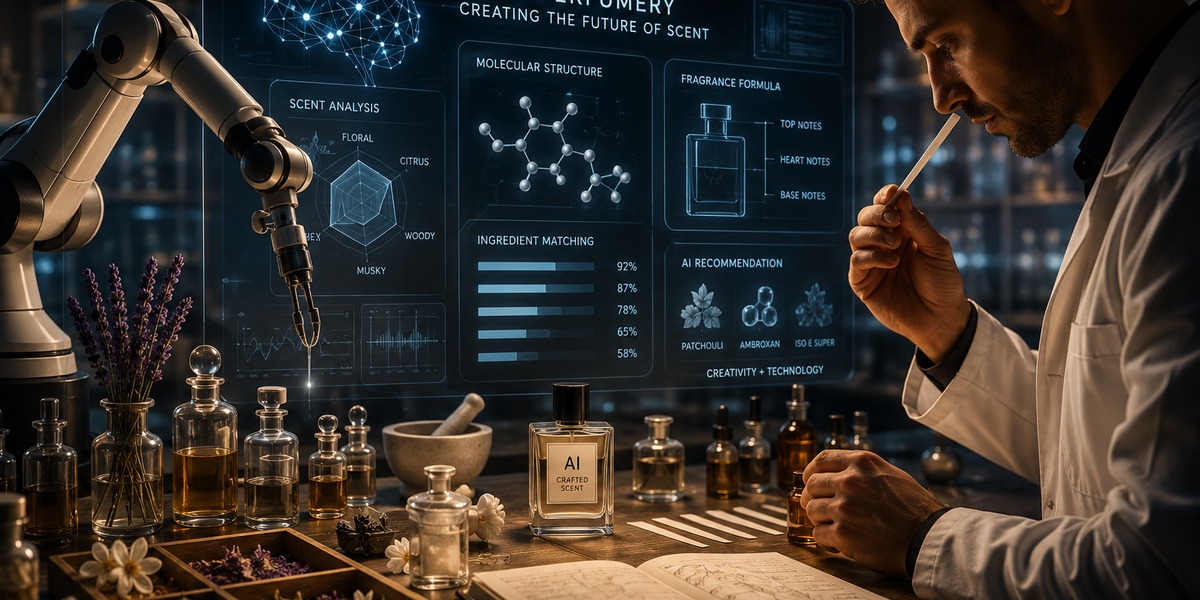
Traditionally, building a new accord — a harmonious blend of multiple ingredients — required years of experience, thousands of trials and an expert nose. AI is compressing that process dramatically. By training on vast databases of molecular structures, olfactory descriptors and consumer preference data, AI models can now suggest novel ingredient combinations that no perfumer would have instinctively reached for.
Companies like Givaudan and Firmenich have already deployed AI platforms that generate accord proposals based on a desired scent profile. The perfumer then evaluates, refines and brings the human sensibility that transforms a formula into a fragrance with feeling. The creative leap still belongs to the perfumer — AI simply expands the palette of possibilities exponentially.
For bespoke houses like Scensora, this opens entirely new territory: rare combinations, unexpected juxtapositions, and accords that feel genuinely original rather than derivative of existing classics.
One of the most persistent challenges in perfumery is longevity — how long a scent lasts on skin, fabric and in the air. This is governed by the volatility of each ingredient, its molecular weight, its interaction with skin chemistry and its concentration relative to other materials. Historically, perfumers balanced these factors through intuition and iteration.
AI changes this entirely. Machine learning models can now predict the evaporation rate, diffusion behaviour and substantivity of complex formulas before a single drop is blended. By analysing thousands of existing formulas against real-world performance data, AI can recommend precise adjustments — increasing fixative content, modifying base note ratios, or substituting a volatile top note — to achieve a target longevity profile.
The result is fewer reformulation cycles, less ingredient waste, and fragrances that perform consistently across different skin types, climates and application methods. For luxury bespoke creations, this means every bottle delivered to a client performs exactly as intended — every time.
Perhaps the most consumer-facing application of AI in fragrance is scent profiling — using data to understand an individual's preferences and recommend or create a fragrance that feels genuinely personal. AI models process inputs ranging from lifestyle questions and emotional associations to colour preferences, music tastes and even purchase history to build a rich olfactory profile.
Beyond recommendation, AI can also translate abstract emotional briefs into precise ingredient directions. When a client says "I want to smell like a quiet morning in a Japanese garden after rain," AI can deconstruct that brief into specific raw materials — hinoki wood, wet stone accord, green tea absolute, rain molecule — giving the perfumer a structured starting point rather than a blank canvas.
This capability is particularly powerful for bespoke fragrance houses, where the entire value proposition rests on understanding the client deeply and translating their story into scent. AI becomes the bridge between language and formula.
Regulatory compliance is one of the most demanding — and consequential — aspects of fragrance development. The International Fragrance Association (IFRA) sets strict usage limits for hundreds of ingredients based on toxicological research, skin sensitisation data and allergen classification. Manually calculating these limits across a complex formula containing 30 to 80 ingredients is time-consuming, error-prone and requires specialist knowledge.
AI is transforming this process. Compliance platforms powered by machine learning can instantly calculate whether a formula meets IFRA standards across all application categories — fine fragrance, rinse-off, leave-on, candle, diffuser — simultaneously. They flag violations, suggest compliant substitutions and automatically update when IFRA amends its standards.
Beyond IFRA, AI models trained on toxicological databases can assess allergen risk, predict potential skin sensitisation scores, and evaluate environmental impact — enabling perfumers to make safer, more responsible formulation decisions from the very first iteration.
AI's influence extends far beyond the laboratory. In marketing, it is giving fragrance brands an unprecedented ability to understand, reach and connect with their audiences. AI-driven analytics platforms process consumer sentiment across social media, reviews and search behaviour to identify emerging scent preferences, trending ingredients and shifting lifestyle values — often months before they surface in the mainstream market.
Generative AI tools are enabling brands to produce high-quality campaign content — copywriting, visual concepts, social media narratives — at a fraction of the traditional cost and time. More importantly, AI enables hyper-personalised marketing: delivering the right story, to the right person, at the right moment, through the right channel.
For luxury fragrance brands, this is transformative. Rather than broadcasting a single message to a mass audience, AI enables brands to craft individualised narratives — speaking to the minimalist in the language of quiet luxury, and to the adventurer in the language of exploration and discovery. The brand remains singular in identity, but infinitely nuanced in expression.
Understanding what consumers will want next — before they know themselves — has always been the holy grail of any creative industry. In fragrance, AI is making this possible at scale. By analysing patterns across fashion, wellness, food, travel, music and cultural movements, AI models can identify the early signals of emerging scent preferences with remarkable accuracy.
A rise in interest in forest bathing and biophilic design, for example, correlates predictably with increased demand for green, mossy, woody and earthy fragrance profiles. An uptick in wellness culture signals growing appetite for aromatherapeutic, skin-close and functional fragrances. AI connects these cultural dots in real time.
For perfumers and brands, this means arriving at the trend rather than chasing it. At Scensora, we use these insights to stay ahead of what our clients will desire next — ensuring that every bespoke creation we develop today feels timely, relevant and deeply resonant when it reaches the world.
AI is not a threat to the art of perfumery — it is its most powerful new ally. At Scensora, we embrace these tools not to replace human creativity and intuition, but to amplify it. Every formula we create still begins with a story, a feeling and a human conversation. AI simply helps us realise that vision with greater precision, safety and depth than was ever before possible.
- AI generates novel accords by training on molecular and olfactory databases, expanding the perfumer's creative palette.
- Longevity and performance can now be modelled computationally before a formula is physically blended.
- Scent profiling and brief translation tools are making bespoke fragrance more precise and deeply personal.
- IFRA compliance and allergen calculation are faster, safer and more accurate with AI-powered regulatory tools.
- AI marketing enables luxury fragrance brands to deliver hyper-personalised narratives at scale.
- Predictive trend forecasting allows brands to arrive at the next movement rather than react to it.