
Natural vs Synthetic Fragrance Oil Ingredients
No debate in modern perfumery generates more heat — or more misunderstanding — than the question of natural versus synthetic ingredients. On one side: the belief that natural equals pure, safe and superior. On the other: the reality that some of the most transformative, ethical and beautiful fragrance molecules ever created have come from a laboratory rather than a field.
The truth, as with most things in perfumery, is considerably more nuanced than either position allows. Understanding the real difference between natural and synthetic fragrance ingredients — their origins, their characters, their advantages and their limitations — is essential knowledge for anyone who takes fragrance seriously, whether as a wearer, a collector or a creator.
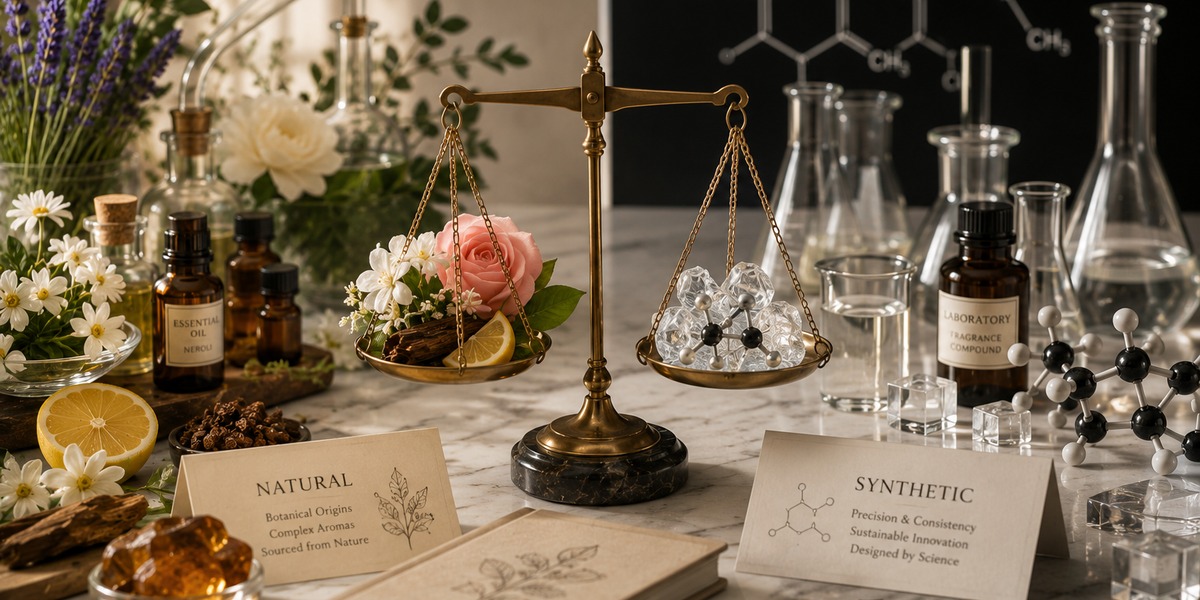
Natural fragrance ingredients are aromatic materials derived directly from plant, animal or mineral sources through physical or chemical extraction processes. They include essential oils, absolutes, CO₂ extracts, resins, concretes, tinctures and distillates — each extraction method yielding a slightly different character from the same source material.
Essential oils are the most familiar natural format — aromatic compounds extracted from plant material through steam distillation or cold pressing. Lavender, bergamot, neroli, vetiver, sandalwood and rose otto are essential oils. They contain the full complexity of the plant's aromatic profile — typically hundreds of individual aroma compounds in precise ratios that give each natural its characteristic character and depth.
Absolutes are produced through solvent extraction followed by alcohol washing, capturing aromatic compounds that steam distillation cannot reach — particularly the more delicate florals. Jasmine absolute, rose absolute, orange blossom absolute and tuberose absolute are produced this way. Absolutes are typically richer, more concentrated and more faithful to the living flower than essential oils, but the trace solvent residues they can contain make them unsuitable for some applications.
CO₂ extracts represent a modern advancement — using supercritical carbon dioxide as a solvent that leaves no residue and captures a broader aromatic profile than steam distillation at lower temperatures, preserving heat-sensitive molecules that are destroyed in conventional distillation. CO₂ extracted ginger, frankincense, oud and vetiver often smell more faithful to the raw material than their steam-distilled equivalents.
Synthetic fragrance ingredients are aroma chemicals created through chemical synthesis in a laboratory — either built from scratch using petrochemical or plant-derived feedstocks, or isolated as single molecules from natural materials and then reproduced synthetically for consistency and scale. The term "synthetic" covers an enormous range of materials, from simple single molecules to extraordinarily complex structures that took decades of research to develop.
Isolated naturals — such as linalool (from lavender or ho wood), citronellol (from rose or citrus) or eugenol (from clove) — are individual aroma chemicals that occur naturally but are produced synthetically for purity and consistency. Chemically identical to their natural counterparts, these are sometimes described as "nature-identical" and occupy a middle ground between natural and synthetic.
Novel synthetic molecules have no natural equivalent — they are creations of chemistry that nature never produced. These include some of the most celebrated materials in modern perfumery: Ambroxan (the radiant marine-skin molecule), Iso E Super (the woody-cedar molecule beloved in modern masculine fragrance), Cashmeran (a warm, spicy, cashmere-like material), and the family of macrocyclic musks that define clean, modern musk perfumery.
Biotech-derived synthetics represent the newest frontier — molecules produced through fermentation, molecular biology or upcycling of natural waste materials. Biotech vanillin, fermentation-derived ambroxan and upcycled rose molecules are chemically indistinguishable from natural or conventional synthetic equivalents but produced through entirely biological processes, combining the purity of synthetics with the sustainability of naturals.
Neither natural nor synthetic ingredients are universally superior. Each has distinctive strengths and genuine limitations that make a skilled combination of both the foundation of the finest perfumery.
- Strengths:
- Multi-dimensional complexity — each natural contains hundreds of aroma compounds that interact in ways no single synthetic can replicate
- Living character — naturals evolve and develop on skin in organic, unpredictable ways that feel alive
- Emotional resonance — connection to real plants, places and natural processes that carries meaning beyond scent
- Warm skin effect — many naturals have an innate affinity for human skin chemistry
- Limitations:
- Batch variation — no two harvests of rose absolute or vetiver smell identical; consistency is impossible to guarantee
- Allergen potential — many naturals contain potent allergens (cinnamaldehyde, linalool, eugenol, geraniol) restricted by IFRA
- Supply chain vulnerability — drought, disease, geopolitical events can devastate supply and quality
- Conservation concerns — many botanical sources face over-exploitation pressures
- High cost — genuine naturals of quality are expensive; dilution and adulteration are widespread
- Strengths:
- Perfect consistency — every batch of a synthetic molecule is chemically identical; performance is guaranteed
- Safety profile — extensive toxicological testing provides data that many naturals simply do not have
- Creative range — synthetics create scent experiences impossible in nature (clean rain, metallic, solar, abstract)
- Biodegradability — modern macrocyclic musks and newer synthetics are designed for environmental safety
- Sustainability — no harvest, no land use, no species pressure in biotech-derived formats
- Limitations:
- Linear character — single molecules lack the multi-layered complexity of whole naturals
- Perceived artificiality — some consumers remain resistant regardless of quality or safety profile
- Older generation concerns — certain early synthetic musks (nitro musks, some polycyclics) had legitimate safety issues now addressed
- Can feel "cold" — some synthetic-heavy formulas lack the warmth and skin-affinity of natural-rich compositions
The history of modern perfumery cannot be told without these six synthetic molecules. Each one opened a creative territory that had never existed before — demonstrating that the laboratory can be as profound a source of olfactory innovation as the most biodiverse rainforest.
One of the most important — and least discussed — issues in the natural fragrance ingredient market is adulteration: the practice of diluting, stretching or substituting natural materials with cheaper synthetics or lower-grade alternatives, while marketing and pricing the product as genuine natural. The prevalence of this practice across the supply chain makes "natural" a far less reliable label than most consumers assume.
Rose absolute adulteration is among the most common. Genuine Bulgarian rose absolute — produced from Rosa damascena at a yield of approximately one gram per kilogram of petals — costs thousands of dollars per kilogram. The fragrance ingredient market is flooded with "rose absolute" that has been extended with geraniol, citronellol, phenylethyl alcohol and synthetic rose compounds to dramatically reduce cost while maintaining a superficially rose-like profile. Only analytical testing — gas chromatography-mass spectrometry — can reliably detect this adulteration.
Oud adulteration is even more widespread. Because genuine natural oud oil is so extraordinarily expensive, it is frequently diluted with cheaper fragrant oils — papyrus oil, cedar oil, synthetic oud accord bases — and sold as pure oud. The price differential between genuine and adulterated oud can be tenfold or more.
Sandalwood, bergamot, neroli and many other premium naturals face similar challenges. This reality means that a formula claiming to be "all natural" may contain as many — or more — synthetic molecules as a formula that honestly discloses its aroma chemical content. Provenance verification, supplier audits and analytical testing are the only reliable defences.
At Scensora, we do not subscribe to the ideology of either camp. We are neither "all-natural" purists nor advocates for synthetic-only formulation. We are quality advocates — selecting each ingredient, natural or synthetic, for what it uniquely contributes to the specific fragrance we are creating, and for the integrity with which it can be sourced and used.
In practice, this means that every Scensora bespoke formula is a considered combination of the finest naturals and the most thoughtfully selected synthetics available. A rose at the heart of a formula is rose absolute from a verified Bulgarian supplier — not diluted, not adulterated. The musk that anchors the base is a macrocyclic musk of the finest quality — biodegradable, skin-safe and deeply beautiful. The ambery warmth that extends the formula's longevity may come from an authentic ambergris note or from Ambroxan — chosen based on what serves the formula and the client best.
We believe that this approach — rigorous sourcing, honest formulation, transparent ingredient philosophy — represents the only defensible position in modern perfumery. The natural vs synthetic debate is ultimately a distraction from the real question: is this fragrance made with integrity, skill and genuine care for the person who will wear it? At Scensora, the answer is always yes.
The most honest thing we can say about the natural vs synthetic debate is this: it is the wrong question. The right question is whether the ingredients in your fragrance — natural or synthetic — are of genuine quality, honestly sourced, responsibly used and skilfully combined. A fragrance built on adulterated "naturals" and poor-quality synthetic fillers is inferior to one built on verified natural essences and the finest aroma chemicals, regardless of which category dominates. Quality, provenance and craft are the only variables that truly matter.
- Natural ingredients offer irreplaceable complexity and living character; synthetic ingredients offer precision, consistency and creative range beyond nature's limits.
- Natural does not mean safe — many natural ingredients are among the most potent allergens in perfumery; many synthetics have excellent safety profiles.
- Adulteration is rampant in the natural ingredient market — rose absolute, oud, sandalwood and neroli are among the most frequently diluted or counterfeited materials.
- Six synthetic molecules — Ambroxan, Iso E Super, Hedione, Cashmeran, Galaxolide, Muscenone — fundamentally changed what fragrance could be and remain central to modern perfumery.
- Biotech-derived synthetics represent the best of both worlds: the purity and consistency of synthetics with the sustainability profile of naturals.
- The finest fragrances use both — selected by quality, provenance and creative purpose, not by ideology.