
Clean Perfumery: What It Really Means
"Clean" has become one of the most powerful — and most abused — words in the beauty and fragrance industry. Brands deploy it freely, consumers respond to it instinctively, and yet there is no universal definition, no governing standard and no regulatory requirement that a product must meet before it earns the right to call itself clean.
The result is a landscape of genuine innovation sitting alongside sophisticated greenwashing — and for consumers who genuinely care about what they are applying to their skin and releasing into their environment, navigating this landscape requires real knowledge. This article gives you that knowledge.
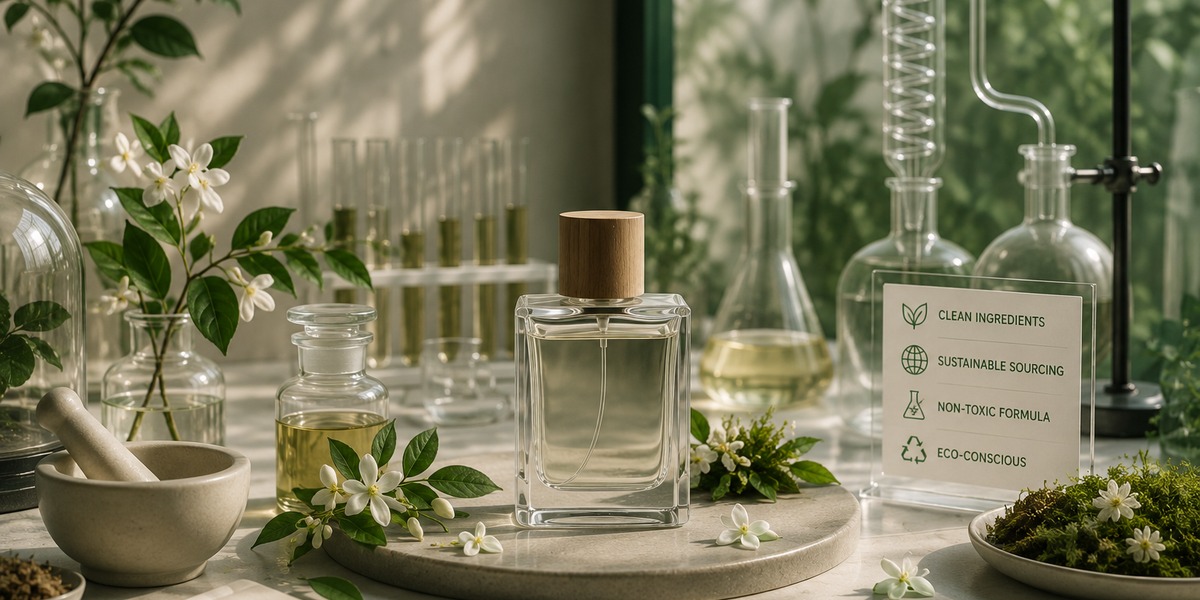
Unlike the food industry, where "organic" and "natural" carry legal definitions enforced by regulatory bodies, the fragrance industry has no universal clean standard. Any brand can print "clean" on a bottle without meeting a single verifiable criterion. This is the foundational problem that every informed consumer needs to understand before evaluating any clean fragrance claim.
In practice, "clean" in fragrance typically signals one or more of the following: the absence of certain controversial synthetic chemicals, a commitment to non-toxic or skin-safe ingredients, the use of sustainably sourced naturals, reduced environmental impact in production, or transparent ingredient disclosure. The challenge is that different brands define each of these differently — and many use the language selectively.
The most credible clean fragrance brands are those that provide full ingredient transparency, adhere to recognised third-party certification standards such as COSMOS, EWG Verified or Ecocert, and make verifiable commitments to sustainable sourcing and responsible manufacturing. These brands exist — but they are a minority. Knowing how to identify them is the real skill.
Genuine clean fragrance formulation is defined not just by what it includes, but by what it deliberately excludes. The fragrance industry has historically relied on certain synthetic chemicals that, while legally permitted and widely used, have raised legitimate questions about skin sensitisation, endocrine disruption, environmental persistence and long-term toxicological impact.
- Nitro musks (musk ambrette, musk tibetene) — potential carcinogens
- Phthalates — used as fixatives, linked to endocrine disruption
- Synthetic UV filters (benzophenone) — environmental persistence
- Oakmoss & treemoss absolutes — high allergen potential
- Undisclosed "fragrance" or "parfum" catch-alls — lack of transparency
- Parabens in ancillary fragrance products
- Certain polycyclic musks — aquatic toxicity concerns
- Certified natural essential oils from traceable origins
- Biodegradable musk molecules (Habanolide, Exaltolide)
- Non-sensitising synthetic aroma molecules with full safety data
- Plant-derived alcohol carriers (organic sugarcane ethanol)
- Upcycled and biotech-derived ingredients
- Full INCI ingredient disclosure on all packaging
- IFRA-compliant concentrations across all categories
It is important to note that "natural" does not automatically mean safe, and "synthetic" does not automatically mean harmful. Many natural ingredients — oakmoss, Peru balsam, certain citrus oils — are among the most potent allergens in perfumery. Many synthetic molecules are safer, more consistent and more environmentally responsible than their natural equivalents. Clean perfumery is not about avoiding all synthetics — it is about making informed, responsible choices.
One of the most persistent and damaging misconceptions in the clean fragrance space is the equation of "natural" with "clean" and "synthetic" with "toxic." This is not only scientifically inaccurate — it actively misleads consumers and disadvantages the most responsibly formulated fragrances.
The case against assuming natural equals safe: Cinnamaldehyde, eugenol, linalool, geraniol, citronellol — all naturally occurring in essential oils — are among the most common causes of fragrance-related contact dermatitis. Peru balsam, a natural resin, is so potently allergenic that it has been restricted by IFRA. Wild-harvested oud and civet, while entirely natural, raise serious concerns around species conservation and animal welfare.
The case for thoughtful synthetics: Ambroxan — one of the most beloved modern fragrance molecules — is a synthetic analogue of ambergris that delivers the same warm, radiant skin effect without any involvement of sperm whales. Iso E Super and Cashmeran create textures that no natural ingredient can fully replicate, with excellent safety profiles. Biotech-derived vanillin made through fermentation is chemically identical to natural vanillin but produced without environmental destruction.
True clean perfumery embraces the best of both worlds — selecting natural ingredients for their irreplaceable character and depth, and choosing synthetics that are demonstrably safe, biodegradable and responsibly produced.
Clean perfumery extends beyond the formula itself to encompass the entire supply chain — how ingredients are grown, harvested, processed and transported, and what impact those activities have on ecosystems, farming communities and the climate. This is the dimension that separates genuinely clean brands from those using clean as a marketing label.
Sandalwood provides a compelling case study. Indian sandalwood (Santalum album) has been so heavily over-exploited that it is now critically endangered in its native range. Responsibly sourced Australian or Hawaiian sandalwood, grown on certified sustainable plantations, is the clean choice — despite being synthetic in origin from the consumer's perspective. Similarly, genuine wild oud from old-growth Aquilaria forests raises conservation concerns that plantation-grown or biotech oud does not.
Labdanum, rose absolute and jasmine — some of the most treasured natural ingredients in perfumery — can be produced sustainably and ethically when sourced from certified suppliers who support fair trade practices, biodiversity and community livelihoods. The same ingredients sourced from exploitative supply chains with no traceability represent the opposite of clean, regardless of their natural origin.
Greenwashing — using environmental and wellness language to imply a standard of clean that is not substantiated — is rampant in the fragrance industry. Recognising its patterns protects you from paying a premium for claims that deliver nothing beyond their marketing value.
"Free from" claims without context are the most common greenwashing tactic. "Paraben-free," "sulfate-free" and "cruelty-free" sound meaningful but may be completely irrelevant to the product in question — parabens and sulfates, for example, are not typically used in fine fragrance at all. A brand that leads with these claims may be distracting you from ingredients that do warrant scrutiny.
Vague natural imagery — botanical illustrations, earthy colour palettes, words like "pure," "botanical" and "nature-inspired" — with no accompanying ingredient transparency is a reliable indicator of greenwashing rather than genuine clean formulation.
No ingredient list. Any fragrance brand genuinely committed to clean principles will provide a full or near-full ingredient disclosure. If a brand hides behind "trade secret" protections for its entire formula with no transparency at all, clean is a marketing claim, not a formulation reality.
Third-party certification is the gold standard. COSMOS, EWG Verified, Ecocert, B Corp — these certifications require audited, verified compliance with genuine standards. A brand that carries one or more of these is held to a measurable benchmark. A brand that carries only its own self-created "clean" seal is not.
At Scensora, clean is not a marketing category — it is a formulation standard that we apply to every fragrance we create. Every ingredient in a Scensora bespoke formula is selected against three criteria: safety, quality and provenance. We do not use ingredients that we cannot account for, and we do not make claims that our formulas do not substantiate.
Our natural ingredients are sourced from certified, traceable suppliers across Southeast Asia, Europe and the Middle East. Our synthetics are chosen from the most rigorously safety-tested aroma chemicals available — molecules with comprehensive toxicological data, strong biodegradability profiles and proven skin safety records. Every formula we create is IFRA-compliant across all relevant application categories as standard.
We believe that the most responsible fragrance is also the most personal one. A bespoke fragrance contains only what is necessary to tell your story — no fillers, no cheap fixatives, no undisclosed blends. You know exactly what is on your skin, and exactly where it came from. In a fragrance industry where transparency is the exception rather than the rule, we consider this not just a clean standard — but the only honest one.
The clean fragrance movement, at its best, represents something genuinely important: a demand for transparency, responsibility and integrity from an industry that has historically operated behind a veil of trade secrecy. At its worst, it is a marketing strategy dressed in green clothing. The difference lies in the details — in the ingredient list, the certifications, the supply chain and the honesty of the brand behind the bottle. Ask the questions. Expect the answers.
- "Clean" has no universal regulatory definition in fragrance — it is a brand claim, not a certified standard unless backed by third-party verification.
- Natural does not equal safe — many natural fragrance ingredients are among the most potent allergens known.
- Thoughtful, responsibly produced synthetics can be cleaner than many natural alternatives.
- Genuine clean brands provide full ingredient transparency, sustainable sourcing and recognised third-party certifications.
- Greenwashing is widespread — look beyond "free from" claims and natural imagery to ingredient disclosure and audit trails.
- Bespoke fragrance is inherently cleaner — every ingredient is intentional, disclosed and purposeful.