
Sustainable Perfumery & the Downfall of Mass Perfume Production
The industrial production line that gave the world affordable fragrance at unprecedented scale has been one of the defining achievements of twentieth century manufacturing. It made Chanel No. 5 accessible to millions, created global icons from laboratory formulas, and built the multi-billion dollar fragrance industry as we know it. But the same system that created this accessibility has also created an environmental, ethical and creative crisis that is now, quietly but irreversibly, consuming itself.
The downfall of mass perfume production is not a sudden collapse — it is a slow structural decline driven by converging forces: consumer disillusionment, environmental accountability, ingredient restriction, supply chain fragility and the rise of a new generation of fragrance lovers who want meaning, not volume. Understanding this shift is understanding the future of the entire industry.
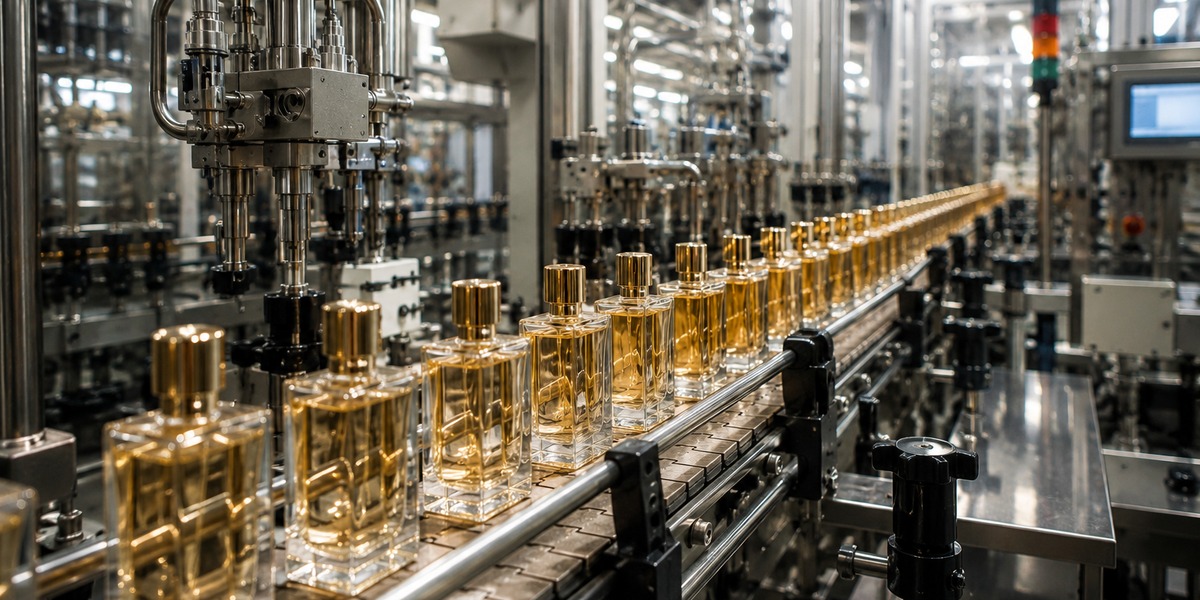
The fragrance industry produces over 30,000 new fragrance launches globally every year. The vast majority of these are mass-market products designed to sell in volume, manufactured using industrial processes that prioritise cost efficiency above all other considerations. The environmental consequences of this model — hidden from the glossy advertising that sells the finished product — are substantial and increasingly impossible to ignore.
The environmental footprint of mass fragrance begins long before the bottle reaches the shelf. Industrial cultivation of fragrance botanicals — jasmine, rose, lavender, vetiver — often involves intensive pesticide and water use, particularly when driven by the price pressure of mass production contracts. The extraction and processing of these materials generates significant chemical waste. Transport across global supply chains contributes substantially to carbon emissions.
The packaging model of mass fragrance is arguably its most visible environmental failure. Elaborate gift sets, oversized boxes, multiple layers of plastic and cardboard, heavy glass bottles designed for shelf presence rather than efficiency — the packaging-to-product ratio in many mass fragrance launches borders on the absurd. Industry estimates suggest that packaging accounts for 60–65% of the total environmental impact of a standard mass market fragrance launch.
And then there is the waste at the end of the chain. With 80% of mass fragrance launches failing commercially, vast quantities of unsold stock are destroyed, reformulated or discounted to clearance levels — representing an enormous waste of the resources consumed in their creation. The system is not merely inefficient; it is structurally committed to overproduction as a business model.
Beyond the environmental consequences, mass production has created a creative crisis in mainstream fragrance that is now becoming impossible to ignore. When fragrance is produced at industrial scale to sell to the broadest possible audience, the creative brief necessarily converges on the lowest common denominator of universal appeal. The result — visible across any department store fragrance counter — is a remarkable homogeneity of scent experience: fresh, safe, inoffensive, easily forgotten.
The hedonic baseline problem: mass market fragrance testing relies on large consumer panels whose responses determine what moves forward to production. Panel testing favours the familiar, the immediately pleasant and the broadly inoffensive — systematically filtering out anything unconventional, challenging or distinctive. The result is that the most creative and memorable potential formulas are eliminated precisely because they provoke strong reactions, while the most forgettable ones advance because they offend no one.
The reformulation spiral: as ingredient costs rise and IFRA restrictions tighten, mass producers are under continuous pressure to reformulate existing products downward — substituting more expensive naturals with cheaper synthetics, reducing the concentration of key materials to maintain margin. Each reformulation moves a fragrance further from its original character. Over a decade of rolling reformulations, the fragrance on the shelf may bear only superficial resemblance to what made the original version beloved.
The launch volume trap: the competitive pressure to launch hundreds of new fragrances annually means that no single launch can receive the creative investment, development time or marketing focus that might allow it to become genuinely significant. Most mass launches are conceived, developed, launched and discontinued within a three-year cycle — too fast to build the cultural resonance that turns a fragrance into a classic.
Sustainable perfumery is not simply mass production with recyclable packaging — a common misrepresentation deployed by major brands as a greenwashing gesture. Genuine sustainability in fragrance requires a fundamental restructuring of how fragrances are conceived, made, sold and used. It looks nothing like the industrial model it is replacing.
- 30,000+ launches per year; 80% fail commercially
- Formula cost 3–10% of retail price
- Ingredients sourced from lowest-cost global suppliers with minimal traceability
- Continuous reformulation to reduce costs and maintain margin
- Elaborate, wasteful packaging designed for shelf presence
- Celebrity and advertising spend dominates budget
- Perfumer rarely credited; creative brief driven by market testing
- Products designed for rapid obsolescence and repeat purchase
- Fewer, more considered launches; each designed to last
- Significant formula investment; ingredient quality is primary
- Traceable, certified sustainable ingredient sourcing
- Formula integrity protected; reformulation avoided or disclosed
- Minimal, recyclable, refillable or compostable packaging
- Investment in craft and creativity rather than advertising
- Perfumer named and celebrated; creative integrity protected
- Products designed for longevity, refill and lasting relevance
The decline of mass fragrance production is not driven by idealism alone — it is driven by a convergence of structural forces that are making the old model increasingly untenable regardless of consumer preferences.
IFRA restrictions and ingredient scarcity are continuously narrowing the palette available to mass producers. As allergen restrictions tighten, as endangered botanicals become unavailable or prohibitively expensive and as synthetic alternatives face scrutiny over biodegradability and skin safety, the cheap ingredient substitutions that underpin mass production economics become harder to sustain.
Retailer consolidation and digital disruption have undermined the traditional mass fragrance distribution model. Department store traffic has declined significantly across Western markets, reducing the reach of the counter-based selling model that designer fragrances depend on. Direct-to-consumer digital channels favour authenticity, story and community — advantages that small, craft-focused houses have over industrial producers.
Generation Z and millennial consumer values prioritise sustainability, transparency, individuality and authenticity in a way that structurally disadvantages mass production. These consumers have grown up with information access that allows them to see through greenwashing, understand supply chains and recognise when a fragrance's price reflects marketing spend rather than quality. They are not loyal to brands — they are loyal to values. And the values of mass production are increasingly difficult to align with theirs.
The social media fragrance community has created an alternative authority structure that bypasses traditional advertising entirely. When a fragrance gains credibility through the recommendations of knowledgeable enthusiasts on YouTube, TikTok and Reddit rather than through a celebrity campaign, the marketing infrastructure of mass production becomes not just irrelevant but actively counterproductive — a signal of inauthenticity rather than aspiration.
As mass production declines, a new fragrance economy is emerging in its place — one defined by craft, meaning, sustainability and the deeply personal. The outlines of this new economy are already visible in the growth of niche fragrance, bespoke creation, refillable formats, community-driven discovery and direct-to-creator relationships between perfumers and their audiences.
The refill revolution is one of the most significant structural changes in fragrance retail. Major houses — Chanel, Dior, Guerlain, Hermès — have introduced refillable fragrance formats that allow bottles to be replenished rather than replaced, dramatically reducing packaging waste while creating deeper brand loyalty. Niche and bespoke houses have operated this way for years; the mainstream adoption signals a genuine structural shift rather than a token gesture.
Biotech and sustainable sourcing are enabling a new generation of perfumers to create formulas of exceptional quality without the environmental cost of traditional natural ingredient harvesting. Fermentation-derived rose, upcycled citrus molecules, plantation-certified oud and lab-grown sandalwood are enabling the creation of fragrances that are both more sustainable and, in some cases, more consistent and beautiful than their conventionally sourced equivalents.
The rise of the perfumer as creator — known by name, followed directly, commissioned personally — mirrors the chef-as-artist movement that transformed the restaurant industry two decades ago. Perfumers like Bertrand Duchaufour, Calice Becker, Francis Kurkdjian and a new generation of independent creators have audiences who follow their work with the same engagement that followers of any creative practitioner would. This direct relationship between creator and audience is the foundation of a fragrance economy built on meaning rather than volume.
At Scensora, we have never operated within the mass production model — and the structural decline of that model does not represent a challenge to adapt to. It represents a validation of everything we have been built on: the belief that fragrance should be made with intention, worn with meaning and created to last.
Our sustainability commitments are not recent additions to our brand story — they are embedded in how we source, how we formulate and how we work with clients. We do not source ingredients from suppliers we cannot verify. We do not reformulate client creations to reduce cost. We do not produce inventory speculatively. Every fragrance we make is made for a specific purpose, for a specific person or brand, using ingredients whose provenance we can account for.
We believe that the future of fragrance is not one bottle produced in millions, but millions of bottles each produced for one person. The technology, the talent and the cultural appetite for this shift all exist. What bespoke creation offers — and what mass production structurally cannot — is a fragrance that carries no environmental guilt, no creative compromise and no question of whether it was made for you. It was made only for you. That is the only truly sustainable luxury.
The fragrance industry is at a crossroads that every mature creative industry eventually reaches: the point at which the logic of scale begins to undermine the very qualities that made the product worth making in the first place. The response is not to abandon the industry but to rebuild it on different foundations — craft instead of volume, meaning instead of novelty, sustainability instead of convenience. This rebuilding is already underway. At Scensora, we believe we are creating not just individual fragrances but the model for what the fragrance industry of the next fifty years will look like.
- The mass fragrance industry launches 30,000+ fragrances annually; approximately 80% fail commercially, representing enormous creative and environmental waste.
- Packaging accounts for 60–65% of the environmental footprint of a typical mass market fragrance launch.
- Mass production's creative model — hedonic baseline testing, continuous reformulation, launch volume pressure — systematically produces fragrance that is forgettable by design.
- IFRA restrictions, retailer disruption, Gen Z values and social media authority structures are all driving structural decline in the mass production model simultaneously.
- The new fragrance economy is defined by craft, meaning, refillable formats, biotech sustainability and direct creator-audience relationships.
- Bespoke fragrance is the most sustainable format that exists — zero overproduction, zero waste, zero formula compromise, made only for the person who will wear it.