
Ambergris, Oud and Musk: The Rarest Scent Materials in the World
In the world of fragrance, most ingredients are measured in kilograms and priced by the litre. A handful are measured in grams and priced like precious metals. And a very few — so rare, so extraordinary and so irreplaceable in their olfactory character — occupy a category entirely their own: materials that have shaped the history of perfumery across millennia, been traded along ancient spice routes, coveted by royalty and fought over by merchants.
Ambergris, oud and musk are three such materials. Each has a story that spans thousands of years. Each has an olfactory character so distinctive, so complex and so deeply embedded in human sensory memory that the fragrance industry has spent decades and billions of dollars trying — and only partially succeeding — to replicate them synthetically. This is their story.
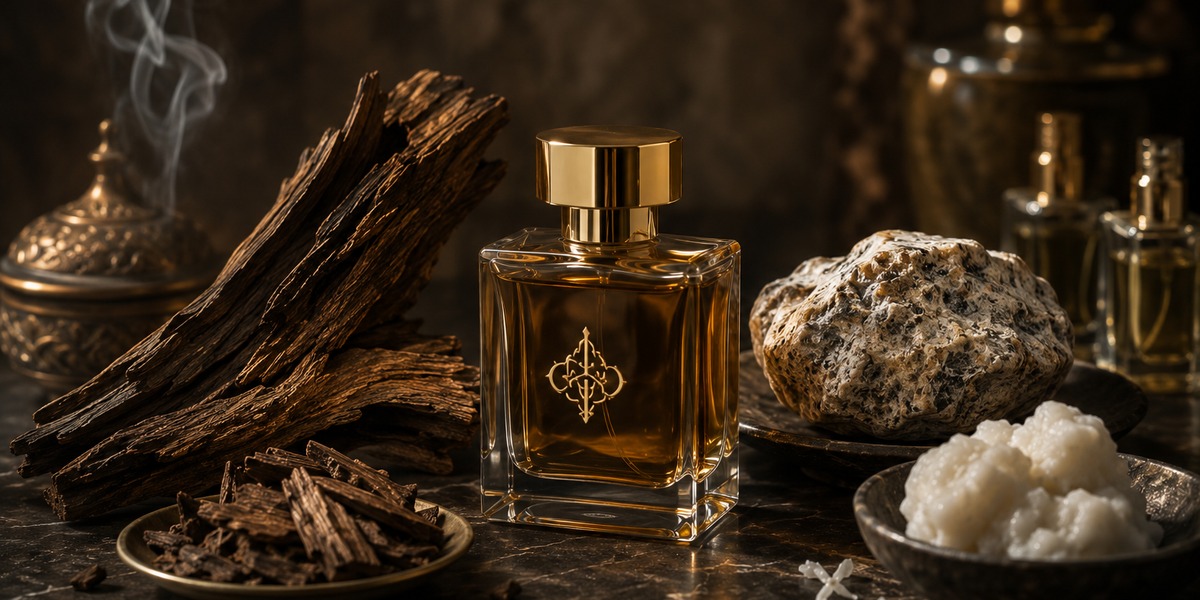
Before exploring each material in depth, here is a snapshot of what makes each one extraordinary — their origin, rarity, price and olfactory character compared side by side.
Ambergris is one of the most improbable substances in the natural world. It begins in the intestine of the sperm whale — the world's largest toothed predator — as a waxy secretion that encapsulates indigestible squid beaks and other hard materials that the whale cannot pass. Over years or decades, this mass grows, hardens and is eventually expelled into the ocean, where it begins a remarkable transformation.
Exposed to salt water, sunlight and oxygen over a period of ten to thirty years, raw ambergris — which smells initially of faeces and the sea — undergoes a complex oxidation process that transforms it into one of the most beautiful and distinctive scent materials in existence. Mature ambergris has a character unlike any other ingredient: warm, radiant, marine and subtly animalic, with an almost ethereal quality that seems to amplify and extend every fragrance it touches.
The olfactory secret of ambergris lies in a compound called ambrein, which breaks down over time into a suite of molecules — most notably ambroxide (also known as Ambroxan) — that have an extraordinary affinity for human skin and olfactory receptors. Ambergris does not just smell beautiful on its own — it makes everything it touches smell more beautiful, projecting further and lasting longer. It is both a fragrance ingredient and the ultimate fixative.
Legal status and alternatives: The trade in ambergris is heavily regulated and banned outright in many jurisdictions due to sperm whale protection. The synthetic equivalent — Ambroxan, produced by Givaudan — has become one of the most important molecules in modern perfumery precisely because it captures the radiant, skin-enhancing quality of the original. Fragrances like Dior Sauvage and many modern niche releases rely on Ambroxan as a central pillar. But perfumers who have worked with genuine aged ambergris consistently describe the synthetic as an excellent approximation of one dimension of a material whose full complexity remains beyond replication.
Of the three materials in this article, oud is the only one still legally available in natural form for perfumery use — and it is the one with the widest price range and the most complex hierarchy of quality. At the upper extreme, genuine wild-harvested Vietnamese or Indian oud of the finest grade — aged resin from old-growth Aquilaria trees, distilled with exceptional care — commands prices that exceed the finest cognac, the rarest saffron and most precious metals.
What justifies this extraordinary value is not scarcity alone, though scarcity is considerable. It is the olfactory complexity that wild oud develops over decades that cannot be rushed, engineered or replicated. A fine wild oud oil contains hundreds of distinct aroma compounds in precise ratios that shift and evolve over the wear period — opening with medicinal sharpness, moving through leather and smoke, settling into a deep, sweet, resinous warmth that persists for days on skin and fabric.
The hierarchy of oud quality is determined by origin, tree age, resin density and distillation method. At the pinnacle: aged wild Hindi or Kynam oud — materials so rare that a single gram of the finest quality may cost more than a thousand dollars. Below this: premium Cambodi, Laotian and Vietnamese wild ouds with their characteristic sweet, fruity or smoky profiles. Then plantation-grown ouds, which offer consistency and traceability at more accessible price points. And at the base of the pyramid: synthetic oud molecules and accord bases that approximate the oud character without the depth, complexity or development of the genuine material.
Kynam — also known as Kyara in Japanese perfumery tradition — deserves particular mention. The rarest form of oud, found only in the oldest and most heavily infected Aquilaria trees, Kynam oud is so exceptional in its olfactory character — simultaneously sweet, bitter, floral, resinous and cool — that it is considered by connoisseurs to be the single most prized fragrance material in the world, with prices to match.
Natural musk — harvested from the musk pod of the Himalayan musk deer (Moschus moschiferus) — has been used in perfumery for over three thousand years. In ancient Chinese medicine, Tibetan spiritual practice and the earliest Arab perfume traditions, musk was considered the most intimate of all fragrance materials — the one that most closely approximated the scent of human skin at its most attractive, and the one most powerfully associated with desire, warmth and sensuality.
The musk molecule at the heart of the natural material — muscone — is extraordinarily powerful. Genuine natural musk has a presence unlike any synthetic equivalent: intensely animalic, deeply warm, and possessed of an almost uncanny ability to merge with skin chemistry and amplify the wearer's natural scent. Perfumers who worked with it in the era before restrictions consistently describe it as the most powerful and transformative fixative in existence — capable of transforming a good fragrance into an unforgettable one.
The conservation reality is unambiguous: to extract a single kilogram of musk pod material, approximately fifty male musk deer must be killed. The resulting devastation to wild populations led to the near-extinction of the species in its Himalayan range, and to the complete banning of natural musk in commercial perfumery under CITES Appendix I — the highest level of international trade restriction, covering the world's most endangered species.
Synthetic musks now dominate perfumery entirely. The progression from nitro musks (now largely banned for safety reasons) through polycyclic musks to the modern generation of macrocyclic musks — Habanolide, Exaltolide, Ethylene Brassylate — represents one of the most successful examples of synthetic chemistry finding not just an alternative but, in some dimensions, an improvement on a natural original. Modern musk molecules are biodegradable, skin-safe and diverse in character, offering clean white musks, warm skin musks, powdery musks and transparent musks that give perfumers extraordinary creative range.
Beyond their individual characters, ambergris, oud and natural musk share one defining property that explains their enduring importance in perfumery across three millennia: they are the most powerful fixatives ever discovered. A fixative is a material that slows the evaporation of volatile fragrance molecules — anchoring a composition to the skin, extending its wear and allowing the full development of top, heart and base notes to unfold over time rather than disappearing within hours.
The reason all three materials have this property is related to their molecular complexity. Each contains large, heavy molecules — ambrein and ambroxide in ambergris, sesquiterpene alcohols in oud, muscone in natural musk — that have an exceptional affinity for skin proteins and lipids. They bind to the skin surface and release their own scent and the scents of other molecules caught in their molecular structure slowly and continuously over many hours.
This is why the finest Oriental fragrances — those built around combinations of all three of these materials — can last on skin for 24 hours or more, developing and evolving throughout that time rather than fading. It is also why their synthetic equivalents, while impressive, rarely achieve quite the same depth of longevity or the same quality of development — the molecular complexity of the originals is simply too vast to fully replicate with any single synthetic compound.
At Scensora, our relationship with these extraordinary materials is guided by three principles: authenticity, responsibility and purpose. We do not use rare materials as marketing claims — we use them when they are the right creative and olfactory choice for a specific bespoke formula, sourced from suppliers whose provenance we can verify and whose practices we endorse.
For oud, we work exclusively with certified sustainable sources — plantation-grown oud of exceptional quality from Cambodia, Malaysia and Laos, and select quantities of aged wild oud from suppliers who can document the provenance of every gram. We do not use oud from unknown sources or suppliers who cannot account for their materials' origin. The difference in cost is significant; the difference in integrity is non-negotiable.
For musk, we have made an absolute commitment to synthetic macrocyclic musks only — not as a compromise, but as the correct ethical choice. The finest macrocyclic musks available today — selected from the catalogues of Givaudan, IFF and Firmenich — give us access to musk characters of extraordinary beauty, diversity and safety that we believe represent the future of this family of materials.
For ambergris, we work with both aged natural ambergris where it is legally acquired and ethically sourced (found floating at sea, never harvested), and Ambroxan as our primary synthetic equivalent. The combination of these two materials — natural and synthetic, each contributing something the other cannot — is one of the defining signatures of our most prized bespoke creations.
The rarest materials in perfumery are rare for a reason — their formation requires time, biological processes and natural conditions that cannot be engineered or accelerated. Working with them is a privilege and a responsibility. At Scensora, we treat every gram of genuine oud, every trace of aged ambergris and every musk molecule — natural or synthetic — with the respect that three thousand years of perfumery history demands. Because a fragrance built on the world's rarest materials carries within it something that no amount of marketing can manufacture: a connection to the natural world that is ancient, irreplaceable and profound.
- Ambergris, oud and natural musk are the three most historically significant — and most expensive — fragrance materials in the world.
- Ambergris forms over decades in the open ocean from sperm whale intestinal secretions; genuine aged ambergris can cost $10,000–$50,000 per kilogram.
- The finest wild Kynam oud can exceed $100,000 per kilogram — making it the most expensive natural fragrance material on Earth.
- Natural musk from the Himalayan musk deer is completely banned under CITES Appendix I; all perfumery musk today is synthetic.
- All three materials share the property of being powerful fixatives — they anchor fragrance to skin and extend longevity through molecular complexity that binds to skin proteins.
- Synthetic equivalents — Ambroxan, macrocyclic musks, plantation oud — represent responsible modern alternatives that honour the olfactory legacy of the originals.