
The Most Expensive Perfume Ingredients in the World
The price of a luxury fragrance is rarely what it appears to be. Behind the elegant bottle, the celebrated name and the aspirational advertising lies a question that most buyers never think to ask: what is actually in it? And of the ingredients that make a fine fragrance extraordinary, what do they cost — and why?
The answer, for the most precious fragrance ingredients in the world, is staggering. These are materials that command prices comparable to rare gemstones, vintage wines and precious metals — not because of marketing, but because of genuine rarity, extraordinary difficulty of production and olfactory characters that no laboratory has ever fully replicated. This is their story.
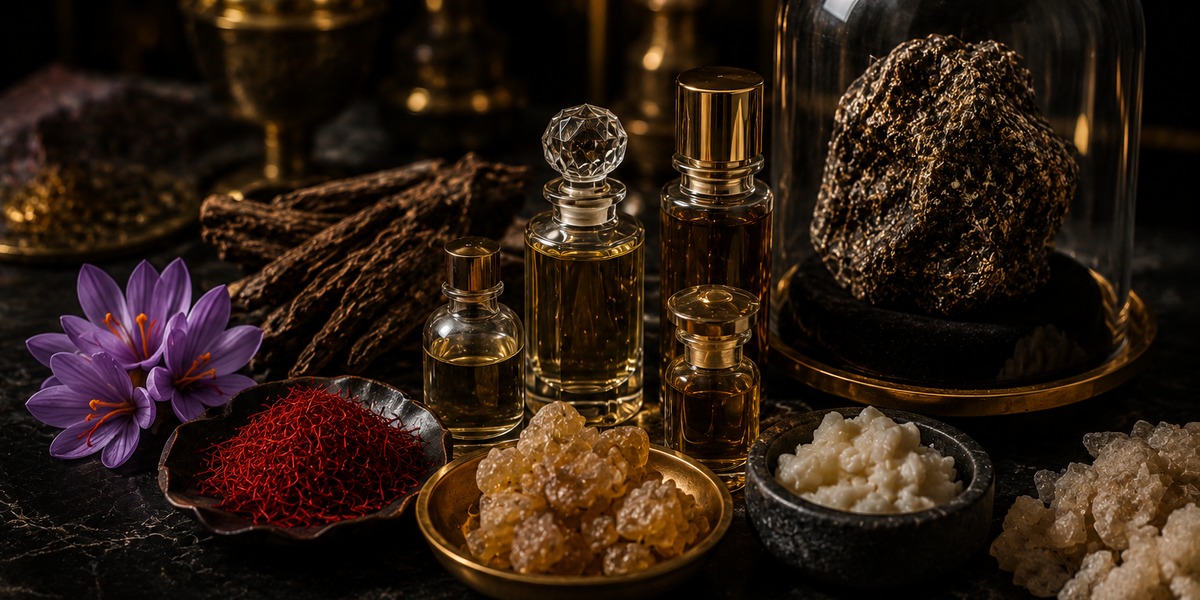
These are the materials that define the upper boundary of what fragrance ingredients can cost — ranked by approximate price per kilogram at the highest quality grade. Prices vary significantly by origin, grade, supplier and market conditions; figures represent verified industry ranges at premium quality.
The extraordinary prices commanded by the world's most precious fragrance ingredients are not arbitrary — they are the direct result of specific, verifiable factors that make each material genuinely irreplaceable. Understanding these factors reveals why no amount of synthetic chemistry has been able to fully displace them from the highest levels of perfumery.
Extreme yield inefficiency is the defining characteristic of the most expensive naturals. Bulgarian rose absolute requires approximately 4,000 kilograms of hand-picked petals to produce a single kilogram of absolute. Orris butter requires six years of cultivation and curing before extraction can even begin. Genuine ambergris requires decades of ocean exposure. These are not inefficiencies that technology can improve — they are inherent to the biological and chemical processes that create the aromatic character in the first place.
Geographic exclusivity adds a further layer of irreproducible rarity. Taif rose grows in a single mountain valley in Saudi Arabia and nowhere else produces an equivalent result. Grasse jasmine grandiflorum has a character — shaped by the specific microclimate, soil and traditional cultivation of the Alpes-Maritimes — that no other origin fully replicates. The terroir of fragrance ingredients is as real and consequential as the terroir of wine.
Narrow harvest windows create supply constraints that cannot be resolved by scale. Bulgarian roses must be picked between 5am and 9am during a six-week window in May-June. Miss the window and there is no second chance until the following year. This temporal constraint means that no matter how much demand exists, the total possible supply of the finest rose absolute is fixed by nature, not by production capacity.
Species protection creates absolute scarcity for certain materials. Natural musk deer pod is completely banned; ambergris trade is restricted in many jurisdictions; wild Aquilaria oud is protected under CITES. These legal frameworks reflect genuine conservation crises and create a ceiling on supply that no amount of money can raise.
Understanding the full price spectrum of fragrance ingredients — from the rarest naturals to the most accessible synthetics — contextualises why certain fragrances cost what they do, and why the fragrance compound typically accounts for such a small percentage of mass market retail prices.
The contrast between the $100,000/kg price of finest Kynam oud and the $50–150/kg price of a synthetic aroma chemical illustrates precisely why mass market fragrances cannot include genuine natural materials at meaningful concentrations and remain commercially viable. A single gram of Kynam oud costs more than the entire formula budget of many mass market fragrances.
Of all the precious fragrance ingredients in the world, orris root absolute has perhaps the most extraordinary production story — one that illustrates better than any other why genuine naturals of the finest quality cannot be rushed, scaled or replicated by chemistry alone.
Orris is derived from the rhizomes — the underground root system — of Iris pallida, grown primarily in the hills around Florence in Tuscany. The iris flowers themselves have little aromatic value. The fragrant compounds develop in the rhizomes, but only after an extraordinarily long maturation process: the plants must grow for three years before the rhizomes can be harvested. The harvested rhizomes must then be peeled, dried and stored for a further three to five years before extraction can begin.
During this extended drying period, a complex series of chemical transformations converts precursor compounds in the rhizome into irones — the family of aroma chemicals responsible for orris's distinctive scent character. Irones are the source of orris's violet-like, powdery, woody, iris-fresh quality — a character so unique and so complex that no synthetic formula has ever convincingly replicated its full depth.
After six or more years of cultivation and curing, the dried rhizomes are steam-distilled or solvent-extracted to produce orris concrete, which is then further processed into orris butter or orris absolute. The yield is approximately 0.1–0.3% by weight — meaning one thousand kilograms of dried rhizome produces just one to three kilograms of the finished material. Combined with the years of cultivation required and the labour-intensive processing, the resulting cost — typically $30,000–$60,000 per kilogram for the finest Tuscan orris — reflects genuine scarcity and irreplaceable time investment.
Saffron occupies a unique position in the world of expensive fragrance ingredients — it is simultaneously the world's most expensive spice and one of the most coveted materials in contemporary niche and bespoke perfumery. Its journey from culinary luxury to fragrance icon is a story of an ingredient whose olfactory complexity was hiding in plain sight for millennia.
The production economics of saffron are among the most extreme in the natural world. The Crocus sativus plant flowers for just two weeks each autumn. Each flower contains only three stigmas — the red threads that constitute saffron — which must be harvested by hand within hours of the flower opening. Approximately 150,000 flowers are required to produce just one kilogram of dried saffron threads. In some of the finest growing regions of Iran and Kashmir, the entire harvest season involves hundreds of workers picking flowers in the pre-dawn hours for two weeks, with each kilogram of finished product representing a staggering labour investment.
In perfumery, saffron absolute offers a character utterly distinct from culinary saffron: warm, leathery, honeyed, slightly metallic, with a rich and animalic depth that anchors fragrances with extraordinary sophistication. The modern generation of saffron-forward fragrances — Initio Oud for Greatness, By Kilian Black Phantom, many Amouage creations — has introduced this once-obscure fragrance ingredient to a global audience and driven demand that has further elevated its price and prestige.
The intersection of saffron with oud — both extraordinarily expensive, both with deep cultural roots in Persian and Middle Eastern tradition — has become one of the defining accords of contemporary luxury fragrance. The combination of saffron's leathery-honeyed warmth with oud's resinous-smoky depth creates a complexity that neither material achieves alone, and that represents some of the most expensive raw material combinations in commercial perfumery.
At Scensora, access to the world's finest fragrance ingredients is not a marketing claim — it is the foundation of what bespoke creation means. When a client commissions a bespoke fragrance from us, they are not receiving a formula built from the cheapest available materials that approximate the desired effect. They are receiving a formula built from the best available materials that achieve the desired effect with no compromises.
This means that when a bespoke brief calls for a rose at the heart, we use verified Bulgarian or Taif rose absolute — not a rose accord built from cheaper synthetic components. When the brief calls for an oud foundation, we source from certified suppliers whose oud we can trace to its origin and whose quality we have evaluated through professional assessment. When saffron depth is required, we use genuine saffron absolute rather than synthetic approximations that deliver only a portion of its character.
The cost of this approach is higher — considerably higher than what goes into the majority of commercial fragrances. But a bespoke fragrance is not a commercial product. It is a singular creation for a specific person that may be worn and treasured for decades. The difference between a formula built on the world's finest ingredients and one built on compromises is the difference between something that deepens and improves over years of wear and something that simply disappears.
For the clients who choose Scensora, the cost of the finest ingredients is not an obstacle — it is the point. They are not buying a fragrance. They are commissioning a piece of olfactory craftsmanship that belongs to no one else, built from materials that have been grown, harvested and processed over years or decades before a single drop reaches the formula. That is what genuine luxury means. And that is what these extraordinary ingredients make possible.
When you understand what the world's most expensive fragrance ingredients cost, and why they cost it, the price of a truly great bespoke fragrance stops seeming extraordinary and starts seeming inevitable. These materials carry within them years of growth, decades of natural process, generations of agricultural knowledge and the accumulated wisdom of thousands of years of perfumery tradition. A formula built on them is not just more expensive than one built on cheap synthetics. It is fundamentally a different category of object — one that carries time, care and natural complexity that no laboratory can manufacture or mass production afford to include.
- Kynam oud exceeds $100,000/kg at finest grade — making it the most expensive natural fragrance material on Earth.
- Orris root absolute requires 6+ years of cultivation and curing before extraction; yield is 0.1–0.3% by weight from dried rhizome.
- Taif rose absolute is harvested from a single mountain valley in Saudi Arabia for just two weeks per year, at dawn only.
- Bulgarian rose absolute requires approximately 4,000 kg of hand-picked petals per kilogram of finished absolute.
- Saffron requires 150,000 hand-harvested flowers for one kilogram — making it simultaneously the world's most expensive spice and a coveted fragrance material.
- The price gap between finest naturals ($100,000+/kg) and synthetic aroma chemicals ($50–500/kg) explains precisely why mass market fragrances cannot include genuine rare naturals at meaningful concentrations.