
The Year in Retrospective: Key Fragrance Developments
The fragrance industry of 2025 is almost unrecognisable from the one that existed in 2019. In just six years, a convergence of global events, cultural shifts, technological breakthroughs and evolving consumer values has reshaped every dimension of how fragrance is created, marketed, sold and worn. Understanding this transformation is not merely a matter of historical interest — it is the essential context for understanding where perfumery is going next.
From the clean beauty revolution and the pandemic-driven home fragrance boom to the rise of AI-assisted creation and the mainstreaming of niche perfumery, each year has brought developments that have permanently altered the landscape. This is the story of that transformation, year by year — and the lessons it holds for what the future of scent will look like.
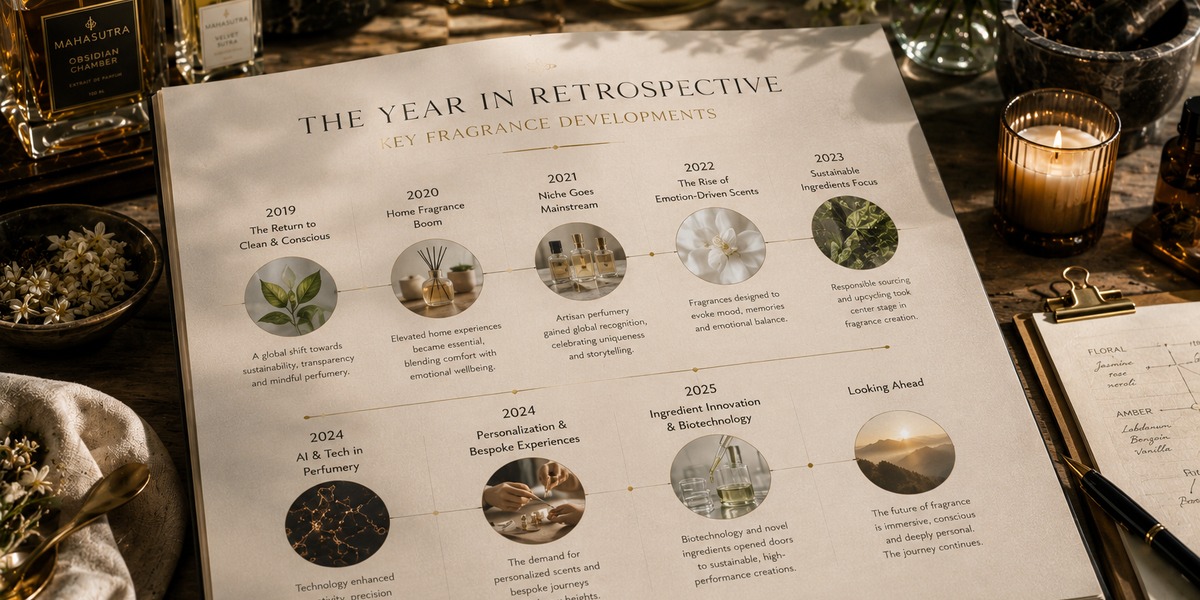
Each year between 2019 and 2025 represents a distinct chapter in the industry's evolution — shaped by events both inside and outside the fragrance world. Here is the story of how each year moved the needle.
By 2019, the clean beauty movement — which had been gaining momentum in skincare for several years — arrived decisively in fragrance. Consumers began scrutinising ingredient lists, questioning the safety of synthetic chemicals and demanding transparency from brands that had historically operated behind a veil of trade secrecy.
Brands like Skylar, Phlur and Dedcool emerged to serve this demand, building their entire identities around clean formulation, transparent ingredient disclosure and sustainable packaging. Simultaneously, the concept of "conscious luxury" began to take root in the niche fragrance world — the idea that the most desirable fragrance was not just the most beautiful, but the most responsibly created.
The global pandemic of 2020 transformed the home into the centre of all life — and with it, home fragrance became not a peripheral category but a central one. Candle sales surged globally as people sought comfort, ritual and sensory pleasure in environments they suddenly could not leave. Reed diffusers, room sprays and aroma oils followed.
More significantly, the pandemic reconnected people with scent on a fundamental level. Locked at home, deprived of the sensory richness of the outside world, people discovered — or rediscovered — the extraordinary power of fragrance to alter mood, evoke memory, create atmosphere and provide comfort. The fragrance industry gained millions of new serious enthusiasts in 2020 who would go on to become niche buyers, bespoke clients and sophisticated collectors.
2021 marked the year niche fragrance definitively crossed into the mainstream consciousness. Driven by fragrance communities on social media — particularly TikTok's #PerfumeTok, which accumulated billions of views — fragrances from houses like Maison Margiela's Replica series, Maison Francis Kurkdjian, Byredo and Creed reached audiences that would never have entered a specialist perfumery.
The language of niche — longevity, sillage, dry-down, skin chemistry, note pyramids — entered popular vocabulary. Consumers who had previously bought whatever was on the department store counter began researching, comparing and seeking out experiences rather than just products. This shift fundamentally changed what people expected from fragrance — and created pressure on designer houses to raise their creative ambitions accordingly.
Emerging from the collective emotional turbulence of the pandemic years, 2022 saw a decisive shift toward fragrances designed not primarily to smell impressive, but to feel supportive. Aromachology — the scientific study of how scent molecules influence mood, stress levels, cognitive performance and emotional state — moved from academic research into commercial fragrance brief-writing.
Brands began explicitly positioning fragrances as mood tools: fragrances to improve focus, to reduce anxiety, to promote sleep, to build confidence. The "functional fragrance" category grew rapidly, with brands like Heretic and Commodity leading the way. Meanwhile, the broader consumer appetite for scents that evoked specific memories, places and emotional states — rather than simply smelling attractive — deepened the relationship between fragrance and storytelling.
2023 was the year sustainability moved from aspiration to expectation in fine fragrance. Driven by tightening CITES regulations on endangered species, growing consumer awareness of environmental impact and the emergence of sophisticated biotechnology alternatives, sustainable ingredient innovation became one of the most active areas of R&D in the industry.
Givaudan's Orpur programme, Firmenich's biodiversity commitment and the rapid growth of biotech-derived aroma chemicals — from upcycled rose petals to fermentation-derived musks — demonstrated that sustainability and quality were not in conflict. Brands that could credibly tell a sustainable sourcing story gained significant competitive advantage. Those that could not began to feel the pressure from a generation of consumers for whom environmental accountability was non-negotiable.
2024 saw artificial intelligence move from experimental tool to practical reality across the fragrance value chain. AI-assisted accord generation, longevity modelling, IFRA compliance calculation and predictive consumer trend forecasting became standard capabilities at the major fragrance houses. The speed of innovation accelerated dramatically — what once took months of iterative lab work could now be explored computationally in days.
In marketing, generative AI enabled hyper-personalised campaigns, AI-powered scent profiling tools began appearing on brand websites and the first commercially viable AI-composed fragrance launches attracted significant media attention. The industry began a serious conversation about creativity, authorship and what it meant for a fragrance to be "created by" a human when AI was deeply involved in the process.
Simultaneously in 2024, the demand for personalised and bespoke fragrance experiences reached levels the industry had not previously seen. Consumers who had spent four years deepening their fragrance knowledge — through lockdown exploration, social media communities and niche discovery — arrived at the natural conclusion of that journey: the desire for something made specifically for them.
Bespoke fragrance houses across Asia, Europe and the Middle East reported significant growth in enquiries and commissions. The profile of the bespoke client shifted — no longer exclusively ultra-high-net-worth individuals but a broader, younger, more engaged audience willing to invest meaningfully in a fragrance that was genuinely theirs. At Scensora, this shift was felt directly — 2024 was our busiest year on record for bespoke commissions across Malaysia, Singapore, Thailand and Hong Kong.
By 2025, biotechnology had moved from promising novelty to established practice in fine fragrance. Fermentation-derived aroma chemicals — vanillin, ambroxan analogues, rose molecules, woody compounds — achieved quality parity with their natural or synthetic equivalents while offering dramatically improved sustainability profiles and supply chain security. The concept of "wild-type" scent materials — molecules identical to natural originals but produced without any natural harvest — became commercially viable at scale.
Novel delivery systems — microencapsulation, skin-reactive release, fabric-binding technologies — began entering commercial fragrance at a meaningful level, enabling fragrances that released scent progressively throughout the day in response to body heat and movement. The convergence of biotechnology, AI and new delivery formats pointed unmistakably toward a future of fragrance that would have seemed like science fiction a decade earlier.
Looking across the six-year arc from 2019 to 2025, five defining patterns emerge that will shape the fragrance industry for the decade ahead.
1. The consumer is now the expert. Social media communities, fragrance education content and the democratisation of niche access have produced a generation of fragrance buyers who are as knowledgeable as professional buyers were a decade ago. Brands that talk down to their audience, obscure their ingredients or rely on celebrity endorsement over substance will find this audience increasingly unreachable.
2. Technology and craft are not opposites. The most significant misunderstanding in fragrance discourse is the assumption that AI and biotechnology threaten craft. The evidence of the past six years suggests the opposite — technology is freeing human creativity from its most laborious constraints, enabling perfumers to spend more time in the creative territory that machines cannot reach.
3. Personal over universal. The trajectory from mass fragrance to niche to bespoke is not a trend — it is a direction of travel that reflects a deeper cultural shift away from mass identity toward individual expression. Every data point in the past six years confirms that consumers increasingly want fragrance that says something specific about them, not something generic about their demographic.
4. Sustainability is now table stakes. By 2025, sustainable formulation and responsible sourcing are no longer differentiators — they are baseline expectations. Brands without credible sustainability credentials are not competing on equal terms. Those with genuine stories to tell are rewarded with loyalty from an increasingly values-driven consumer base.
5. Asia is now a creative force, not just a market. The extraordinary growth of fragrance culture across Southeast Asia, China, Japan and South Korea has produced not just new consumers but new creative voices, new ingredient traditions and new aesthetic sensibilities that are beginning to influence global perfumery in ways that Western-centric fragrance discourse has been slow to recognise.
The patterns of the past six years point toward a fragrance future defined by three intersecting forces: deeper personalisation, greater technological integration and more meaningful sustainability. Here is what we anticipate in the years ahead.
The past six years have not just changed the fragrance industry — they have changed the fragrance lover. The person who engaged with perfume in 2019 and the person who engages with it in 2025 are fundamentally different in their knowledge, their expectations and their relationship with scent. At Scensora, we believe the most exciting chapter of this story is still ahead — in a future where every person who wants a fragrance that is truly theirs can have one, and where the craft of bespoke creation meets the tools of biotechnology and AI to produce something the world has never quite experienced before.
- 2019–2025 represents the most transformative period in modern fragrance history — driven by clean beauty, the pandemic, social media and technology.
- The pandemic's home fragrance boom created millions of new serious fragrance enthusiasts who went on to become niche buyers and bespoke clients.
- TikTok's #PerfumeTok community in 2021 brought niche fragrance language and culture to a mass global audience for the first time.
- By 2025, biotechnology and AI are standard tools in professional fragrance creation — not threats to craft, but amplifiers of it.
- Asia's fragrance culture has grown from consumer market to creative force, producing new aesthetic voices that are reshaping global perfumery.
- The direction of travel is clear: deeper personalisation, greater technology integration and more meaningful sustainability — converging in a future where bespoke creation is accessible to anyone who truly wants it.