
How Long Does Perfume Last? Storage & Shelf Life
Fragrance is one of the few luxury purchases where the product itself is alive — constantly evolving from the moment the bottle is opened, gradually changing as its volatile components interact with oxygen, light and heat over time. Unlike a watch or a piece of jewellery that remains unchanged for decades, a fine fragrance has a natural lifespan, and understanding that lifespan is essential to protecting your investment and experiencing your collection at its best.
The questions of how long perfume lasts, how to store it correctly and how to know when it has passed its peak are among the most searched in the fragrance world — and among the most poorly answered. This guide gives you the definitive, scientifically grounded answer to all three.
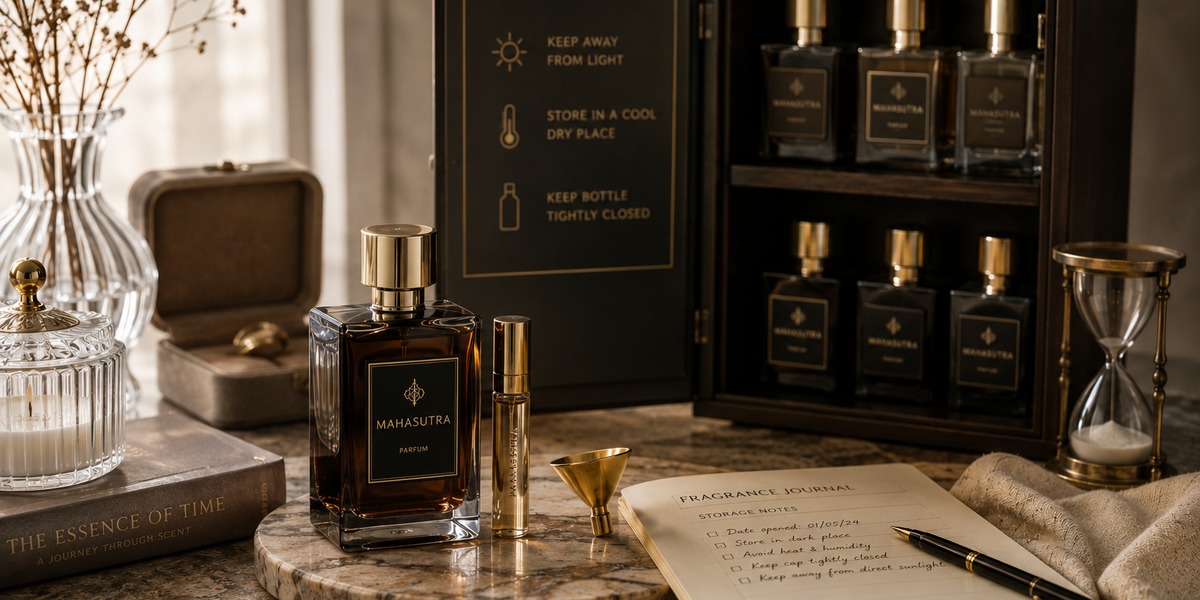
The honest answer to "how long does perfume last?" depends on three variables: the fragrance's concentration, its ingredient composition and how it is stored. There is no universal expiry date, and the industry standard of "3–5 years" that appears on most packaging is a conservative guideline rather than a scientific certainty.
| Concentration | Unopened (ideal storage) | Opened (correct storage) | Opened (poor storage) |
|---|---|---|---|
| Extrait de Parfum (20–40%) | 10–20+ years | 5–10 years | 1–3 years |
| Eau de Parfum (15–20%) | 7–15 years | 3–7 years | 1–2 years |
| Eau de Toilette (5–15%) | 5–10 years | 2–5 years | 6–18 months |
| Eau de Cologne (2–5%) | 3–7 years | 1–3 years | 6–12 months |
| Parfum Oil / Attar | 10–30+ years | 5–15 years | 2–5 years |
Parfum oils and attars are the longest-lasting fragrance format precisely because they contain no alcohol — the primary accelerant of oxidation. Without alcohol to evaporate and carry oxygen into the formula, the fragrance molecules remain stable for significantly longer. Conversely, Eau de Cologne concentrations, with their high water and low oil content, are among the most fragile formats and degrade fastest when exposed to heat and light.
Ingredient composition also matters enormously. Fragrances built primarily on synthetic aroma chemicals — which are chemically stable, consistent and manufactured under controlled conditions — tend to last longer than those dependent on natural essential oils, which contain hundreds of reactive compounds that can oxidise, polymerise or break down over time. A fragrance rich in citrus top notes degrades faster than one anchored in musks, ambers and woody base notes.
Every fragrance molecule is in a state of slow, continuous change from the moment the bottle is manufactured. The three environmental factors that most accelerate this change — and most rapidly degrade the quality, accuracy and longevity of a fragrance — are heat, light and oxygen. Understanding precisely why each is damaging gives you the knowledge to protect against all three.
Heat is the most destructive of the three. Temperature accelerates every chemical reaction, including the oxidation reactions that degrade fragrance molecules and the evaporation of volatile components through even a well-sealed bottle over time. Every 10°C increase in storage temperature approximately doubles the rate of chemical degradation — meaning a fragrance stored in a warm bathroom at 30°C degrades at roughly four times the rate of the same fragrance stored at a cool 18°C. The tropical climate of Southeast Asia makes proper storage particularly critical — ambient temperatures of 28–35°C can halve the effective shelf life of an improperly stored fragrance.
Light — particularly ultraviolet radiation from sunlight and fluorescent lighting — drives photodegradation: a process in which light energy breaks down certain fragrance molecules into new compounds that smell different from, and usually worse than, the original. This is why high-quality fragrance bottles are often made from dark or tinted glass, and why fragrances stored in clear bottles in a sunny spot on a windowsill can change character noticeably within weeks. UV light is particularly damaging to citrus molecules, many florals and certain synthetic aroma chemicals.
Oxygen enters the bottle every time it is opened and through microscopic gaps around the spray mechanism over time. Oxidation alters the chemical structure of fragrance molecules — most damagingly, converting certain alcohol molecules into aldehydes and acids that create off-notes, sharpness or a vinegary character that was not present in the original formula. The more air space in a bottle — meaning the more of the fragrance has been used — the faster oxidation proceeds. A half-empty bottle degrades significantly faster than a full one.
Correct fragrance storage is not complicated — but it requires breaking several habits that most fragrance lovers have developed without thinking about their consequences.
- Bathroom shelf — heat, humidity and steam accelerate degradation faster than almost any other environment
- Windowsill or near windows — direct and indirect UV exposure destroys molecules within weeks or months
- On top of radiators or near heat sources — consistent warmth is as damaging as periodic spikes
- In a car — extreme temperature swings between cold nights and hot days rapidly degrade formulas
- Leaving the cap off between uses — every minute of air exposure accelerates oxidation
- Storing near strong-smelling products — fragrances can absorb ambient odours through porous materials
- Cool, dark drawer or wardrobe — stable temperature, no light exposure, ideal for daily-use bottles
- Original box — the manufacturer's packaging blocks light and provides a degree of temperature insulation
- Dedicated fragrance cabinet away from windows — the single best investment for serious collectors
- Refrigerator for rarely-used bottles — controlled temperature dramatically extends shelf life of precious pieces
- Keep bottles upright — prevents the fragrance from contacting the rubber seal of the spray mechanism
- Decant into smaller bottles when less than half full — reducing air space slows oxidation significantly
Fragrance degradation is rarely sudden — it is a gradual process with identifiable signs that, once you know what to look for, tell you clearly where your fragrance is in its lifespan. Here are the six most reliable indicators.
This is one of the most fascinating questions in fragrance — and the answer is genuinely yes, under specific conditions. The relationship between time and fragrance quality is not always one of decline. Certain fragrance families, ingredient compositions and storage conditions allow fragrances to develop and improve with age in ways that can be extraordinary.
Oriental and chypre fragrances built on a foundation of natural resins, labdanum, oakmoss, musks and base note-heavy accords often benefit significantly from age. The harsh top note edges that can make a fresh fragrance smell almost aggressive on first opening soften over years, the various components integrate more fully and the overall impression becomes rounder, deeper and more harmonious. Vintage collectors of Guerlain Shalimar, Chanel No. 19 or Maison Margiela's Replica series often describe 10–20 year old bottles as superior to current production.
Citrus, fresh and light floral fragrances — those built on highly volatile top notes with minimal base structure — almost never improve with age and typically decline relatively quickly. These fragrances are designed to be experienced at their freshest; a ten-year-old Eau de Cologne, however well stored, is a shadow of what it was.
The collector's paradox: the fragrances most worth collecting and ageing are precisely those whose complexity and depth reward patience — but these are also the fragrances with the highest ingredient quality and the most robust formulas. Cheap fragrances do not improve with age. Masterpieces sometimes do.
One of the less-discussed advantages of bespoke fragrance is the control it gives over shelf life from the formulation stage. At Scensora, we build our bespoke formulas with longevity in mind — not just the longevity of the scent on skin, but the longevity of the bottle over time.
Formula decisions made at the creation stage have significant implications for storage life. A formula anchored in high-quality, chemically stable base notes — musks, ambers, woods and resins — will outlast one whose character depends heavily on reactive top notes. The alcohol carrier we select is pharmaceutical-grade and free of impurities that can accelerate oxidation. Every bottle we deliver is sealed with precision to minimise air infiltration.
We also advise every bespoke client on storage from day one. Given the investment and emotional significance of a bespoke fragrance — a creation that exists nowhere else in the world — proper storage is not optional. We recommend the original box, a cool dark environment, and for clients in Southeast Asia's tropical climate, a dedicated fragrance cabinet with consistent temperature control.
A well-made bespoke fragrance, properly stored, should be a companion for a decade or more — deepening, integrating and evolving in ways that make it feel more like yours with every passing year.
Your fragrance collection is an investment — in beauty, in memory and in the craft of those who created it. Protecting that investment requires nothing more than understanding what harms fragrance and making simple, consistent choices to avoid those harms. Keep your bottles dark, cool and capped. Use your fragrances rather than collecting them without wearing them — fragrance is made to be experienced, not preserved indefinitely. And when a fragrance has genuinely passed its best, let it go. The space it leaves is an invitation to discover something new.
- Extrait de Parfum and parfum oils last longest — up to 10+ years with correct storage; Eau de Cologne is the most fragile format.
- Heat, light and oxygen are the three primary enemies of fragrance quality — any storage environment that limits all three extends shelf life dramatically.
- The bathroom shelf is the worst possible storage location — heat, steam and humidity accelerate degradation faster than almost anything else.
- Cool, dark drawers or dedicated fragrance cabinets are the gold standard; a refrigerator is ideal for rarely-used precious bottles.
- Key degradation signs: colour darkening, vinegary or sharp smell, loss of top notes, reduced longevity, changed character.
- Oriental and chypre fragrances can genuinely improve with age when stored correctly; fresh and citrus fragrances almost never do.
- Decanting half-empty bottles into smaller containers reduces the air space that drives oxidation.