
What Are Top, Heart and Base Notes? The Complete Beginner's Guide
If you have ever read a fragrance description and wondered what "top notes of bergamot and citrus" or "a base of sandalwood and musk" actually means — this article is for you. The language of fragrance notes is one of the most useful tools for understanding, choosing and discussing perfume. And yet it is also one of the most poorly explained, most often misunderstood and most frequently misused terms in the entire fragrance world.
This guide explains it from the beginning — what notes are, why they exist, how to experience them, what the most important ingredients in each tier are and how to use this knowledge to make better fragrance choices. By the end, you will have the vocabulary and understanding of a genuine fragrance enthusiast.
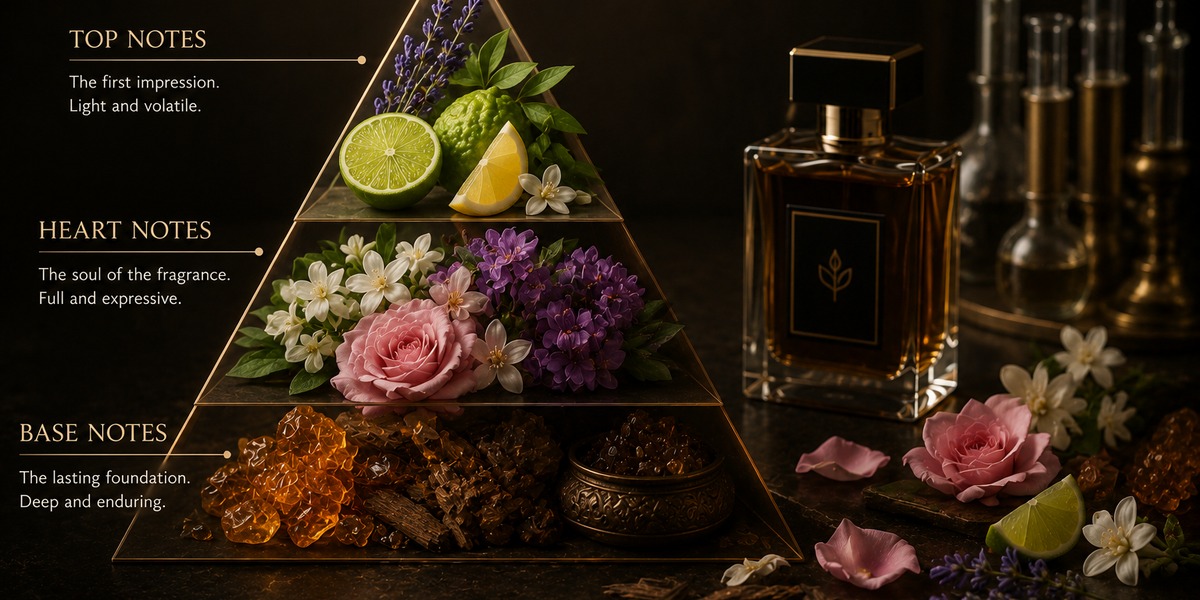
A fragrance note is a single ingredient — or a cluster of ingredients with similar characteristics — that contributes a distinct aromatic element to a fragrance formula. When perfumers talk about the "notes" of a fragrance, they are describing its individual aromatic components in the same way a musician might describe the individual instruments contributing to a piece of music.
The reason fragrances are described in three tiers — top, heart and base — is chemistry. Different fragrance ingredients evaporate at different rates, determined by their molecular weight and volatility. Light, small molecules evaporate quickly; heavy, large molecules evaporate slowly. This means that as time passes after application, different ingredients take prominence — creating a fragrance that changes character as it develops on the skin.
This progression is what makes fine fragrance genuinely fascinating: unlike a perfume that smells exactly the same from first spray to last trace, a well-composed fragrance tells a story over time — revealing new dimensions, deepening in character, and leaving a different impression at hour six than it created at hour one.
Here is a clear, complete explanation of each tier — what it is, when you experience it, how long it lasts and what ingredients typically occupy it.
These are the fragrance ingredients you will encounter most frequently across perfume descriptions — their character, their tier and what they contribute to a formula. Understanding these gives you immediate access to most fragrance vocabulary.
| Ingredient | Tier | Character | Common in |
|---|---|---|---|
| Bergamot | Top | Citrus, green, slightly floral, fresh | Almost every fragrance family; universally versatile |
| Neroli | Top / Heart | Bitter orange blossom, honeyed, slightly medicinal | Fresh, floral, chypre fragrances |
| Rose | Heart | Floral, honey, green, slightly spicy | Florals, orientals, chypres, Middle Eastern fragrances |
| Jasmine | Heart | Warm floral, indolic, slightly animalic | Florals, orientals — the most widely used heart note |
| Iris / Orris | Heart | Cool, powdery, violet-like, woody | Chypres, florals, powdery fragrances |
| Patchouli | Base / Heart | Earthy, dark, sweet, slightly medicinal | Orientals, chypres, gourmands, hippie-era classics |
| Vetiver | Base | Smoky, earthy, woody, slightly citrus | Fougères, chypres, masculine fragrances |
| Sandalwood | Base | Creamy, warm, woody, milky | Almost all families — the most versatile base note |
| Oud | Base / Heart | Resinous, smoky, animalic, complex | Orientals, Middle Eastern fragrances, luxury niche |
| Musk | Base | Clean, warm, skin-close, animalic | Every fragrance — the invisible foundation of most formulas |
| Vanilla | Base | Sweet, warm, creamy, comforting | Orientals, gourmands, soft florals |
| Amber | Base | Warm, resinous, sweet, honeyed | Orientals, Middle Eastern fragrances, warm florals |
Knowing what notes are is one thing. Being able to experience them consciously on your own skin is another — and it is a skill that develops with practice, attention and patience. Here is how to do it.
Step 1 — Spray on skin, not on paper. Fragrance blotter strips are useful for eliminating ingredients you actively dislike, but they tell you almost nothing about how a fragrance will develop. The top, heart and base progression happens in interaction with your skin chemistry — which means skin is the only meaningful test surface.
Step 2 — Note the opening (0–15 minutes). Spray on your inner wrist and evaluate immediately. What do you smell? Bright citrus? Fresh herbs? Clean floral? This is the top note impression — vivid, immediate and fleeting. Notice it, but do not make decisions based on it.
Step 3 — Return at 30 minutes. The top notes have now largely faded. Smell your wrist again. The character has almost certainly changed. What has emerged? Florals? Spice? Wood? This is the heart beginning to express itself. This is a much more reliable indicator of whether you will love this fragrance long-term.
Step 4 — Return at 2–3 hours. The heart is now in full development. Smell again — and also consider the impression you have been receiving in the hours since application. The base notes are beginning to assert themselves: warmth, depth, persistence. Does the character please you? Does it feel like you?
Step 5 — The dry-down (4–6 hours). What remains on your skin after most of the formula has evaporated is the true dry-down — the base note impression that will define the lingering presence of this fragrance. If you love what you smell at this stage, you have found a fragrance worth committing to.
The most practical application of understanding fragrance notes is using them to make better purchasing decisions. Rather than walking into a store and spraying randomly, or buying based on advertising imagery, you can now approach fragrance selection with real intention.
Identify your preferred heart notes. Since heart notes define the long-term character of a fragrance, your preferences here are the most important guide to what you will love wearing day after day. Do you consistently return to floral fragrances? Rose and jasmine hearts are your territory. Do you prefer something grounded and earthy? Look for iris, patchouli and vetiver in the heart. Something fresh and aromatic? Lavender, geranium and herbs belong here.
Choose base notes for longevity and feel. If you want a fragrance that lasts all day, look for heavy base note materials — oud, sandalwood, amber, vetiver, musks — in the formula. If you prefer something lighter and more skin-close, seek out formulas with transparent musks and minimal resinous base materials.
Use top notes to narrow your initial evaluation. If you detest certain top note ingredients — sharp citrus, herbal openings, medicinal aldehydes — look for fragrances that don't feature them prominently. But always go beyond the top notes before making a final decision.
At Scensora, our bespoke process begins exactly here — by understanding your note preferences across all three tiers, identifying patterns in what you have loved and what has disappointed you, and using that map as the starting point for a formula that is built specifically around your olfactory identity. Knowing your notes is the first step toward knowing your scent.
Every expert fragrance wearer was once a beginner who sprayed something on a blotter, liked the opening, bought the bottle, and was surprised or disappointed by what emerged an hour later. Understanding notes does not prevent that experience from ever happening — fragrance is still full of surprises — but it gives you the tools to learn from it, to understand why it happened and to make better choices next time. The language of fragrance is not gatekeeping — it is an invitation. And it begins with three words: top, heart, base.
- Top notes are the first impression — bright and fleeting (15 min – 2 hrs). Never judge a fragrance based on top notes alone.
- Heart notes are the soul — the core character that defines the fragrance during most of its wear (2–6 hours).
- Base notes are the foundation — the deepest, most enduring elements that linger for hours and act as fixatives (4–24+ hrs).
- Always test fragrance on skin, not paper — the pyramid develops through the interaction of molecules with your unique skin chemistry.
- Evaluate at 0 min (top), 30 min (heart emerging), 2–3 hours (full heart), and 4–6 hours (dry-down/base) for a complete picture.
- Your heart note preferences are the most reliable guide to what fragrances you will love long-term.
- Olfactory adaptation ("nose blindness") is why you stop smelling your own fragrance — it is still there; others can smell it clearly.