
The Best Fragrance Families & How They Work Together
Every fragrance ever created belongs to a family. These families — defined by their dominant character, shared ingredients and common emotional tone — are the fundamental grammar of perfumery. Understanding them does not diminish the magic of fragrance. It deepens it, giving you a vocabulary to describe what you love, identify what you are drawn to, and discover new territories you might never have explored without a map.
More importantly, understanding how fragrance families relate to each other — which ones complement, which ones contrast, which ones layer beautifully — elevates your ability to build a wardrobe of scents, layer intelligently and communicate precisely with a perfumer about what you want. This is the knowledge that separates a casual fragrance wearer from someone who truly inhabits their scent.
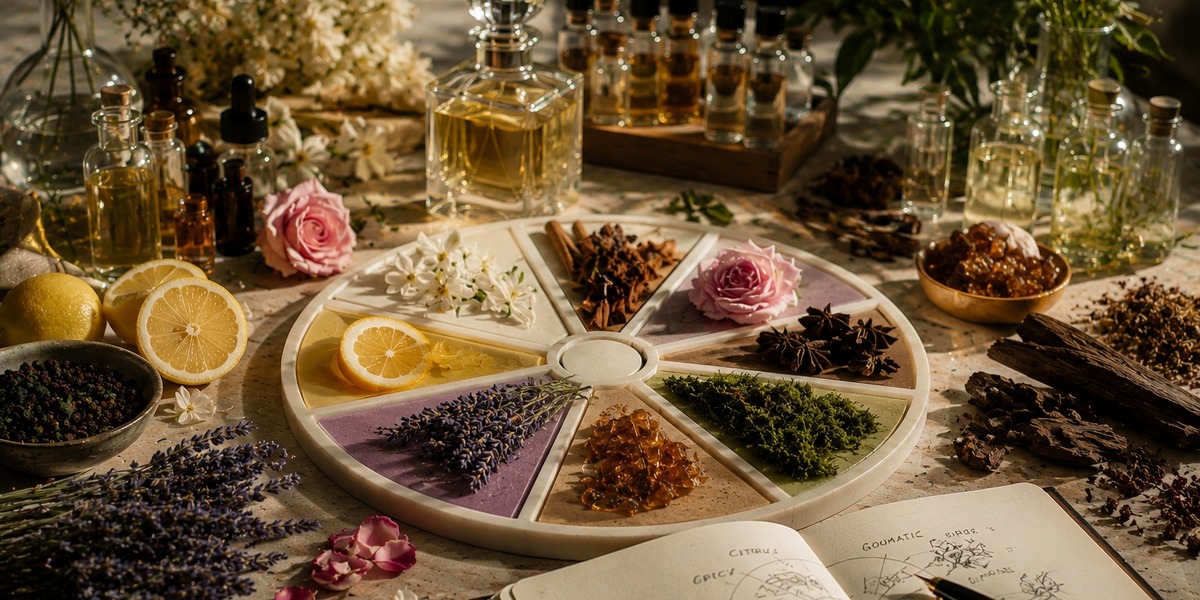
The fragrance wheel — developed by perfumer Michael Edwards in 1983 and continuously refined since — organises all fragrances into families based on shared olfactory characteristics. While different classification systems exist, the eight families below represent the most widely recognised and practically useful way to navigate the fragrance landscape.
Floral fragrances account for the largest share of global fragrance production — and with good reason. The floral family is extraordinarily diverse, ranging from the single-note purity of a soliflore (a fragrance centred entirely on one flower) to the complex grandeur of a multi-floral bouquet blending rose, jasmine, peony, iris and tuberose into a seamless, layered composition.
Rose is the most widely used natural ingredient in perfumery. Rose absolute and rose otto — extracted from Damask rose (Rosa damascena), primarily grown in Bulgaria and Turkey — are among the most expensive natural materials in the world, and among the most versatile. Rose pairs beautifully with oud (a classic Middle Eastern combination), with patchouli (creating depth and earthiness), with musk (adding warmth and skin-close intimacy) and with citrus (creating fresh, modern interpretations).
Jasmine — particularly Jasmine Sambac from India and Jasminum grandiflorum from Grasse — contributes an indolic, animalic richness that gives floral fragrances their full-bodied, almost edible quality. White florals — jasmine, tuberose, gardenia — are the most complex and challenging of the family, with an intensity and richness that makes them extraordinarily powerful on skin.
Iris occupies a unique position — both a floral and a powdery note simultaneously, with its characteristic orris root character delivering a cool, violet-like, almost metallic quality that adds tremendous sophistication to any floral composition.
The Oriental family — also called Amber — is defined by its warmth, richness and exceptional staying power. Rooted in thousands of years of Middle Eastern and South Asian perfumery tradition, Orientals are built around resinous, balsamic, sweet and animalic materials that develop slowly on the skin, deepening over hours rather than fading.
The classic Oriental accord centres on the interplay of amber (a blend of benzyl benzoate, labdanum, vanilla and musks), oud (for animalic depth and wood), incense (for smokiness and spirituality) and spices — particularly saffron, cardamom and black pepper — that add warmth and complexity.
Soft Orientals are a more accessible sub-family — lighter in resinous density, often incorporating florals (particularly rose and jasmine) to create bridges between the Oriental and Floral families. These work exceptionally well in tropical climates, where full Oriental density can become overwhelming in humidity and heat.
The evolution of the Oriental family in modern perfumery has been toward refinement and wearability — replacing heavy animalic materials with elegant musk structures, using oud CO₂ rather than raw oud distillate, and incorporating transparent woods to lighten the traditional Velvet density of the family without losing its fundamental warmth.
The fragrance wheel is not merely a classification system — it is a guide to compatibility. Families that sit adjacent on the wheel share qualities that make them naturally complementary. Families on opposite sides of the wheel create contrast — which can be either jarring or brilliantly tension-creating, depending on the skill of the combination.
| Family | Works Beautifully With | Why It Works | Avoid Pairing With |
|---|---|---|---|
| Floral | Woody, Chypre, Fresh Citrus, Soft Oriental | Wood grounds florals; citrus lifts them; amber warms them | Heavy aquatic — clashes with floral complexity |
| Oriental | Floral, Woody, Spicy, Gourmand | Florals add brightness; wood adds structure; spice amplifies warmth | Aquatic — opposing energies create dissonance |
| Woody | All families — woody is the universal bridge | Wood grounds any formula; sandalwood smooths; vetiver adds depth | Very few combinations fail with a skilled woody base |
| Fresh / Citrus | Aquatic, Floral, Fougère, Light Woods | Shared brightness and energy; citrus lifts without overwhelming | Very heavy oriental — fresh notes disappear immediately |
| Gourmand | Oriental, Woody, Floral, Spicy | Vanilla anchors beautifully to amber and wood; spice adds sophistication | Aquatic, green — opposing sensory registers |
| Chypre | Floral, Fruity, Woody | The mossy-citrus accord of chypre needs floral or fruity brightness to balance | Very sweet gourmand — conflicts with dry chypre character |
Just as a clothing wardrobe requires range — pieces for different occasions, seasons, moods and contexts — a fragrance wardrobe should span multiple families to serve the full breadth of your life. The most sophisticated fragrance lovers do not wear one signature scent exclusively — they curate a considered selection that gives them the right scent for every moment.
A well-considered fragrance wardrobe for a tropical climate might include: a light floral or fresh citrus for daily professional wear; a woody oriental or soft amber for evening and social occasions; a clean skin musk for intimate, quiet days at home; and a concentrated oud or chypre for special events and formal occasions.
For cooler, temperate climates, the wardrobe might shift: a fougère or aromatic woody for everyday office wear; a full oriental or gourmand for winter evenings; a chypre for its timeless versatility across seasons; and a green or floral for the warmer months when lightness is appropriate.
The fragrance wheel is a tool, not a cage. The most interesting and lasting fragrances — particularly in the bespoke and niche space — are those that resist easy classification, existing at the intersection of multiple families and refusing to be fully defined by any single category.
A bespoke fragrance created at Scensora for a client might open as a fresh citrus-green (Fresh family), develop through a heart of white florals and spice (Floral-Oriental intersection), and settle into a woody amber base that anchors the whole composition with warmth and longevity (Oriental-Woody). This fragrance belongs simultaneously to multiple families — and precisely because of that refusal to stay in one territory, it has a complexity and character that no formula restricted to a single family can achieve.
At Scensora, we use the fragrance wheel as a starting language — a way to understand a client's instincts and preferences — but we never allow it to limit what we create. The brief that excites us most is the one that says: "I love florals but I want something that feels deeper. I want warmth but not heaviness. I want to smell unmistakably myself." That is a brief that lives between the families. And it is exactly where the most extraordinary fragrances are born.
Understanding the fragrance families does not make fragrance more clinical — it makes it more accessible. When you can name what you love, you can find more of it. When you understand what works together, you can layer with intention. And when you understand the boundaries of the wheel, you are ready to appreciate — and commission — the fragrances that transcend them. The wheel is the beginning of the conversation. What Scensora creates is the fragrance that happens when that conversation goes somewhere entirely your own.
- The eight major fragrance families — Floral, Oriental, Woody, Fresh, Fougère, Chypre, Gourmand, Aquatic — organise all fragrances by shared olfactory character.
- Adjacent families on the wheel are naturally complementary; opposite families create contrast that requires skill to resolve successfully.
- Woody is the universal bridge family — it works with virtually every other family and is the most versatile base for any formula.
- A well-curated fragrance wardrobe spans at least three families: fresh/day, rich/evening, and skin-close/intimate.
- The most memorable fragrances live between families — at the intersection of multiple territories simultaneously.
- Bespoke creation uses the fragrance wheel as a starting point, then transcends it — building complexity that no single-family formula can achieve.