
The Art of Fragrance Layering
Fragrance layering — the practice of wearing multiple scents simultaneously to create a combined effect greater than any single fragrance alone — is one of the oldest techniques in perfumery and one of the most exciting frontiers of modern scent culture. From the attar-on-attar traditions of Middle Eastern perfumery to the contemporary practice of combining niche fragrances and body products to build a personal signature, layering is both an art form and a deeply personal act of creative expression.
Done well, layering creates a scent that is uniquely yours — impossible to exactly replicate, impossible to buy off a shelf. Done carelessly, it creates a muddled, competing clash that satisfies no one. This guide gives you the principles, the technique and the practical recipes to layer with confidence and intention.
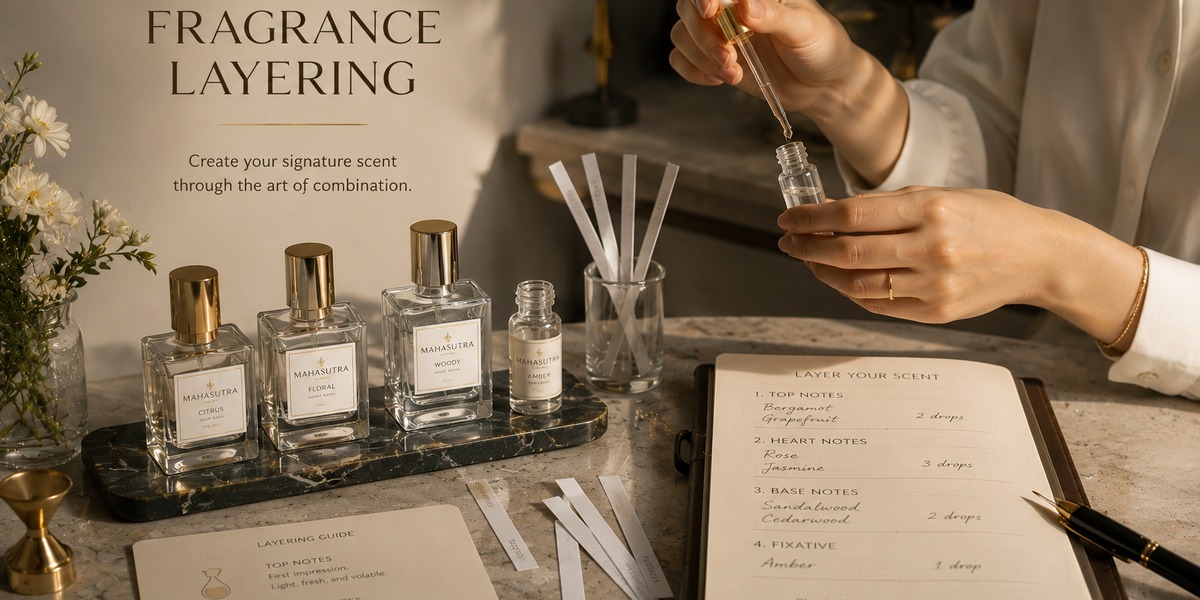
Fragrance layering works because scent molecules from different products interact on the skin in ways that neither product would produce alone. When two fragrances are applied in sequence, their volatile molecules intermingle on the skin's surface, blending in real time to create a third, emergent scent experience — one that neither fragrance could produce independently.
This is not random — it is chemistry governed by the same principles that guide professional perfume formulation. Ingredients with complementary volatility profiles — a fast-evaporating citrus top from one product interacting with the deeper amber base of another — create a natural accord that evolves beautifully over the wear period. The lighter product's top notes lead; as they fade, the richer product's base notes take over; the combination creates a natural arc of development that mimics the structure of a professionally composed fragrance.
The ancient tradition of Middle Eastern perfumery has understood this for centuries. In the Arab world, layering multiple attars — pure fragrance oils applied directly to skin — is standard practice, not experimentation. Oud on the wrists, rose on the neck, musk behind the ears and a woody resin on the chest creates a symphony of interlocking notes that evolves throughout the day in a way that a single fragrance never could.
The most reliable framework for layering fragrance follows a four-layer structure that mirrors the architecture of a professionally composed fragrance — foundation, body, heart and crown. Apply each layer in sequence, allowing each to settle briefly before the next.
Layering without principle produces chaos. These rules do not restrict creativity — they give it a structure that makes success reliable rather than accidental.
Rule 1: Apply heaviest first, lightest last. Always layer from densest to most volatile. Oils and thick bases go on first, closest to skin. Light sprays and citrus fragrances go on last, at the outer layer. This sequence ensures each layer has something to anchor to and evaporates at the right pace.
Rule 2: Stay within or adjacent to your fragrance family. The most reliable layering combinations involve fragrances from the same family or adjacent families on the fragrance wheel. Woody + Oriental = seamless. Fresh + Floral = luminous. Chypre + Woody = sophisticated. The further you venture across the wheel, the more risk you take — though calculated risk is where the most surprising discoveries live.
Rule 3: One anchor, one accent. In any layered combination, one fragrance should be the foundation — richer, deeper, longer-lasting — and the other should accent rather than compete. Two dominant fragrances of equal weight tend to clash. One strong base + one lighter accent creates harmony.
Rule 4: Less is more, always. Layering multiplies the intensity of fragrance on the skin. What feels appropriate for a single fragrance may become overwhelming when combined. Start with half the amount of each product you would normally use and build up only if needed.
Rule 5: Test on skin before committing. Layering combinations that smell wonderful on paper or in the air can behave entirely differently on your skin chemistry. Always test a new combination on your wrist, allow 20 minutes, then evaluate before applying to your full body.
These three recipes represent different moods, occasions and fragrance territories — each demonstrating how layering can create a distinct, complex scent experience that no single fragrance could replicate alone. Apply each layer in sequence with a one-minute interval.
- Sandalwood body oil Base — skin
- Rose EDP — pulse points Heart — 2 sprays
- Oud attar — wrists only Depth — 1 drop
- Saffron or amber spray Crown — 1 spray
- White musk lotion Base — skin
- Clean floral EDP Body — 2 sprays
- Bergamot or citrus EDT Accent — 1 spray
- Floral hair mist Crown — hair
- Vanilla amber body oil Base — skin
- Skin musk EDP Body — 2 sprays
- Cashmeran or tonka oil Depth — chest
- Warm wood spray Crown — 1 spray
The layering approach that works beautifully in a cool European autumn requires significant adjustment for a hot, humid Southeast Asian afternoon. Climate is one of the most important variables in any layering strategy, and ignoring it produces combinations that are either invisible or overwhelming depending on the direction of the error.
In hot, humid climates — Malaysia, Thailand, Singapore, the Philippines — body heat and humidity dramatically amplify the projection of any fragrance applied. Layering in tropical conditions requires restraint above all. A single drop of oud attar as an anchor, topped with a light fresh floral at half-normal intensity, creates a sophisticated layered effect without overwhelming projection. Heavy Oriental combinations that work magnificently in winter can become oppressive in tropical humidity.
In cooler climates and air-conditioned environments, the challenge reverses — reduced skin temperature and dry indoor air limits natural projection. Here, richer, deeper layering is not only appropriate but necessary. A warm body oil, a concentrated EDP at full intensity and a hair mist in the same family creates the projection and longevity that cooler conditions require. Oriental, Woody and Chypre layering combinations excel in these conditions.
The most sophisticated form of fragrance layering is not the combination of two finished fragrances — it is the deliberate construction of a scent experience using raw fragrance components: pure essential oils, attars, fragrance concentrates and aroma chemicals that allow you to compose, in real time, directly on your skin.
This is the territory that bridges layering and bespoke creation. When a client works with Scensora on a bespoke commission, the early consultations often involve exactly this kind of exploratory layering — placing different raw materials on different pulse points, evaluating how they interact with the client's skin and each other, discovering unexpected combinations that neither client nor perfumer would have arrived at through conventional brief-writing alone.
What emerges from this process — after refinement, calibration and professional formulation — becomes the bespoke fragrance. But the insight that makes it possible comes from layering: from the willingness to experiment, to trust the nose over expectation, and to accept that the most extraordinary scent you will ever wear might be something you discover rather than commission.
At Scensora, we offer fragrance layering workshops where clients explore this process themselves — guided by our perfumers, using our raw material library, building layered combinations that often become the brief for their bespoke creation. It is the most direct path we know from fragrance lover to fragrance author.
Layering is the most democratic form of fragrance creativity — it requires no laboratory, no professional training and no expensive equipment. It requires only curiosity, a willingness to experiment and the understanding that the best fragrance you will ever wear might be something you build yourself. Start with one complementary combination. Wear it for a day. Notice what it does on your skin, how it develops, what you would change. That process — of observation, adjustment and refinement — is exactly how perfumers work. You are already closer to creating your own scent than you think.
- Layering creates an emergent third scent that neither fragrance produces alone — the interaction happens in real time on your skin.
- The four-layer method — wash, oil, EDP, hair mist — builds fragrance in the same structural sequence as a professionally composed formula.
- Apply heaviest first, lightest last. One anchor fragrance + one accent creates harmony; two dominant fragrances compete.
- Fragrances from the same or adjacent families layer most reliably — Woody + Oriental, Fresh + Floral, Chypre + Woody.
- In tropical climates, use half-intensity of each layer — heat and humidity amplify projection dramatically.
- Exploratory layering with raw materials is the most direct path from fragrance lover to a genuinely personal bespoke creation.